


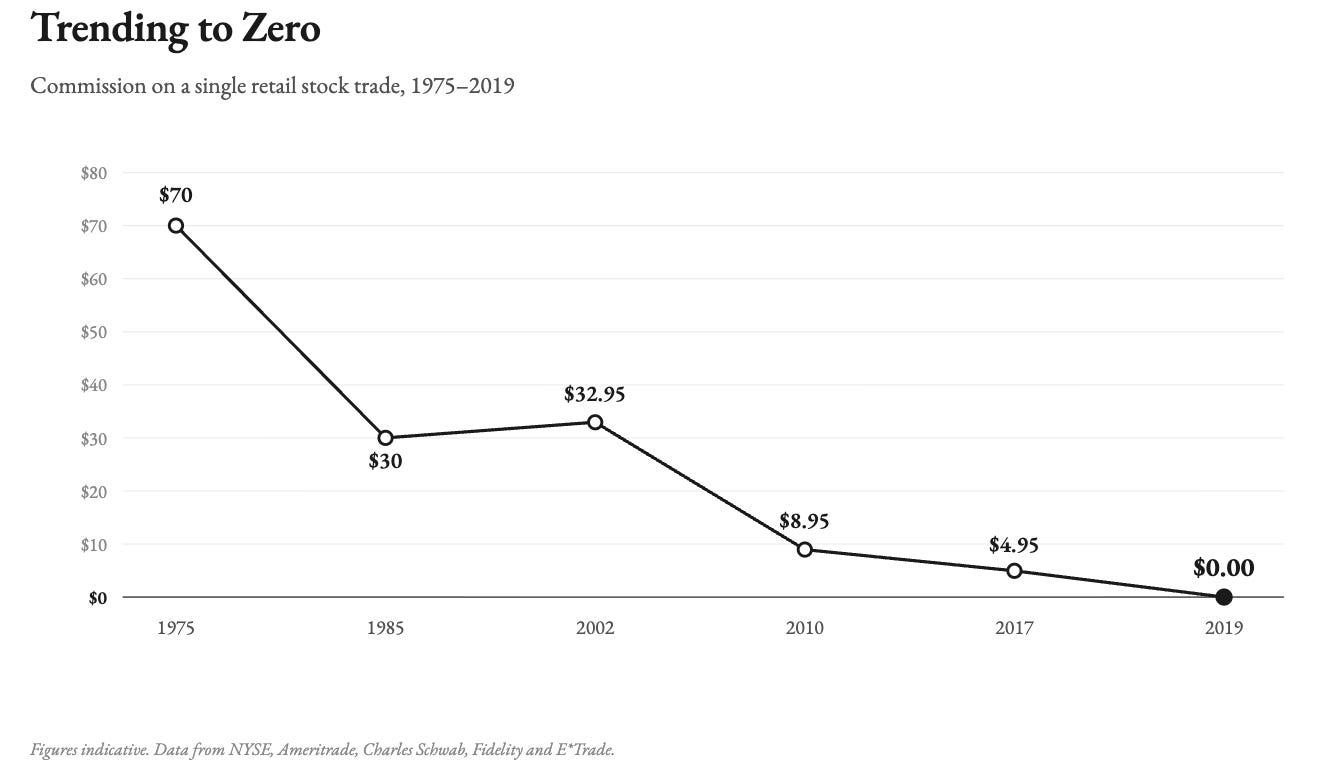
On May 17, 1792, a group of twenty-four brokers and merchants rallied around a buttonwood tree on Wall Street, New York. Together they agreed that 0.25% would be the absolute minimum that would be charged on a stock trade. By 1975, between tiered costs and complex pricing, that number would inflate as high as 1 to 2%. In 1975, the SEC would deregulate the NYSE’s pricing - setting the stage for what we now know as zero-fee exchanges.
When a transaction becomes as easy as a click, what do you even charge for as an exchange? Robinhood and Charles Schwab now run exchanges with zero commission. Lighter has been teased with bringing the model to crypto.
The story of financial exchanges is that of costs gradually trending to zero. All transactions are simply the movement of information about who gives what asset (usually dollars) in exchange for another asset. If the cost of storing, moving and validating information has gone lower due to Moore’s law, what would be the fate of exchanges? Do they have more value to be created by being a full-stack banking product? Are there parallels in traditional markets?
This is what I set out to find answers to in today’s piece. It is a sponsored collaborative exploration written with the team at Grvt. We have been obsessively studying perpetual exchanges for the past quarter at DCo. We did well taking a position in Hyperliquid last year. Our cheque into Drift followed in Feb.
Grvt’s name repeatedly emerged in all of the charts we studied. What made our interactions refreshing was that instead of looking at exchanges as platforms for speculation, their philosophy was to build the whole stack for a transparent, verifiable brokerage. How it works and why it matters is what we will explore today.
Let us begin with an understanding of how exchanges became what they are.
Trending to Zero
Right around the time we were on our mission to the moon, in 1969, Wall Street was running a different experiment. They began asking what if we allowed large institutions to trade through a network digitally instead of having to deal with the human operators at the New York Stock Exchange? Surely, they would have less liquidity as the network would have fewer participants, but they would have instant accessibility to one another. The system was called Instinet. Created by Institutional Networks Corporation in 1969, the exchange was created for institutional investors to buy and sell orders to one another through a computer network. It was an early instance of what would eventually be known as an Electronic Communication Network.
The NYSE had its own electronic trading network as early as 1984 - named SuperDOT. It too focused on allowing orders to be taken digitally. In 1987, when the Black Monday crash happened, the value of the network became apparent. Traditional avenues that took orders through telephone lines were saturated as investors rushed to sell. ECNs like Instinet continued to allow large market participants to trade with one another. By 2001, Instinet would be responsible for close to 15% of all Nasdaq volume and a considerable share of NYSE-listed stocks; SuperDOT was doing close to 99% of NYSE’s volume.
Both these networks focused on institutions. The next evolution would focus on allowing everyone to trade.
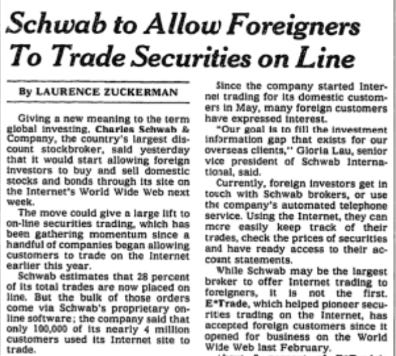
When Charles Schwab launched online in 1996, online trading still represented only a small portion of brokerage activity. Within three years, it had completely transformed the industry. By 1999, Charles Schwab had more than 3.6 million online brokerage accounts, and the firm was processing over 1 million online trades per day through its internet platform. In the early 1990s, a typical retail stock trade cost between $40 and $50 in commissions. By the end of the decade, many online brokerages were offering trades for less than $15.
Financial markets had undergone a two-step transformation.
The 1980s were about the gradual digitisation of markets.
The 1990s were about its democratisation.
Thanks to the internet and improvements in computer hardware, everyone could trade from the comfort of their homes. The dot-com boom became the perfect macroeconomic environment for these trends to converge and bring trading online.
Over the next two decades, that $15 sum would also trend to zero. In the 1970s, your stockbroker could charge up to 2% because there was a complex network of paperwork behind the scenes each time you purchased shares of GEICO alongside Warren Buffett. The stock settlement would take five days; the reconciliation from your bank to the stock custody avenue would take time. All of this required human labour. What do you charge for when a stock transaction is just the click of a button? How do you justify charging to click that button when there are multiple peers like Robinhood, Interactive Brokers and their regional variants willing to do it for free?
This would be the billion-dollar question that sets the stage for zero-fee brokerage platforms. As early as 2001, the Bank for International Settlements teased the idea that Moore’s law would change how market pricing works. If everyone can have powerful computers, and networks can move increasingly larger sums of information, then it will change how we transact. That transition did happen. By the late 2010s, high-frequency trading and algorithmic orders were responsible for bringing more liquidity and efficiency to the market. Robinhood and Charles Schwab made zero-fee trade structures common by 2020.
How do they make money then? The BIS, in 2001, speculated that exchanges would make money through payment for order flow and have their own market-making divisions. In the 1980s, an order would cost you money. Today, in aggregate, that order should have you being compensated instead because exchanges bundle that information in aggregate and sell it to firms like Citadel. The exchanges have marginal costs in clearing a transaction. Their earnings, however, come from selling aggregate information of how their users are placing orders. There would be one more avenue for these exchanges to make money. That would be sweeping accounts.
When you move $10k to Robinhood to trade crude oil, the money does not sit idle. Until you take a position, it can be routed by Robinhood into a high-yield account paying Robinhood two to three per cent a year. The $200 on your account alone may not seem like much, but in the aggregate it becomes valuable. Robinhood had close to $32.1B in cash-sweep balances in FY 2025. Charles Schwab owns a bank, so it can take its own customers’ deposits, put them in its own bank, and keep a larger share of the interest rate. (This post from 2019 is a great breakdown of how discount brokerage’s unit economics work.)
Both these businesses are economies-of-scale ventures. These things work only when there are hundreds of billions of dollars in idle deposits. For scale, consider that Robinhood had $324 billion in combined platform assets. Of which, $32.4B was just cash. Crypto-native perpetual exchanges, in contrast, have peaked at $5B in cumulative TVL. This is why most exchanges still have transaction fees. Both Hyperliquid and Lighter have explored directly receiving a portion of interest rates generated from USDC deposited on their platforms. But at the heart of all challenges with perpetual exchange monetisation within crypto is the fact that we have not yet evolved to be an economy-of-scale ecosystem. To have economies of scale, we need tooling that grows wealth without requiring individuals to monitor the situation constantly.
To understand where this goes, we need to understand how the perpetual exchange ecosystem within crypto itself came to be.
So Decentralised
Decentralised perpetual exchanges are the third-highest revenue-generating category within crypto. The largest is stablecoin issuers (like Tether and Stable), with decentralised exchanges (like Uniswap) a close second. Both these categories have benefitted tremendously from the network effects of having over eight years to evolve to be what they are. Perpetual exchanges, in contrast, have been a recent phenomenon.
For context, cumulative volume on all perpetual exchanges each month was at $62B in Jan of 2022. In Jan of 2026, that number was at $964B. The same month in 2022 saw only $100k generated in fees across the category. In 2022, it had $3.3M in fees generated in a single month. Cumulative volume across all exchanges hit $14 trillion as of writing this note. Of that, close to $4T was in Q4 of 2025 alone.
Perpetual exchanges as an ecosystem produce the king of hockey stick charts that have conventionally been witnessed only in Web2 software products.
The reasoning for it is fairly straightforward.
First, perpetual exchanges have now reached a level of maturity where the experience is at parity with centralised exchanges. Users would rather hold on to their assets and have immediate withdrawal than take on the risks of a centralised avenue. Unlike FTX, asset custody risks on these exchanges are fairly low.
Second, they allow users to have exposure to new assets far faster than centralised avenues like Coinbase. In Q1 of 2024, Hyperliquid was consistently earlier than Binance to list new meme-economy assets. The trend continued in Q2 of 2025, when the same exchange began listing pre-market perps for newly released tokens. When SpaceX and CRBRS were listed earlier this year, perpetual exchanges were the best avenues to trade them pre-listing.
Perpetual exchanges can generate far more monetary velocity than peers like lending. In the process, they generate fees. For instance, the average day in Jan of 2026 saw each dollar of TVL on Hyperliquid’s HLP vault generate $24 in volume. Last month, each dollar in TVL on Hyperliquid alone generated $0.0053 in fees.
These exchanges are primitives that combine the best aspects of crypto in a single market. They allow global-scale price discovery, real-time settlement, and instantaneous movement of money. Users do not have to worry about where their capital resides, as it is often verifiable via smart contracts. Perpetual exchanges also vastly expand the surface area of what can be traded upon.
Startup equity, commodities, and indices can all find an avenue to be traded and settled via perpetual exchanges.
Perpetual exchanges help take the target addressable market for all of crypto from a small community of spot traders who often traded crypto-native assets to the world. Most of the assets traded in the first wave of spot-native decentralised exchanges were oriented towards individuals from within the industry who knew what tokens were used for. It could have represented a governance asset, a utility token or simply memetic value. But the vast majority of individuals on the web did not care enough about them. By expanding the asset types, perpetual exchanges made crypto-native financial infrastructure relevant for the whole world.Instead of having users trade niche assets, perpetual exchanges create global-scale markets for commodities and equities.
Annual volume has evolved from $648B in 2023 to $6.7T in the past year.
As with any sector expanding that rapidly, perpetual exchanges have seen competition emerge. When multiple players are involved, part of the focus shifts towards business models. We saw Lighter mount a challenge for a brief while with its low-cost fee model, but that has not quite stood up against the behemoth. Part of the thesis is that the most productive aspect of an exchange is the yield it can generate, since exchanges naturally become hubs for individuals to park assets as collateral.
Who owns the yield?
If you were a banker in the 15th century, you would see a golden age for finance. Double-entry accounting was starting to pick up steam in Florence. Foreign currency exchange and lending across cities were also coming of age as trade between medieval-age cities in Europe picked up steam. Part of what was up for debate was lending - and lending rates. Interest rates have long been a heated matter of discussion within finance. Shakespeare’s work famously involves a creditor demanding a “pound” of flesh from a borrower who defaults on his debt. Usury - or the act of charging excessive amounts of interest - has been considered deeply sinful in human society for quite some time.
As humanity evolved and trade went global, longer lines of credit became essential. Against the backdrop of the manias of the 18th century, where Newton famously lost his money, was the evolution of lending markets and insurance. Many of these ideas are caught well in The Price of Time if you would like to read it. Perpetual exchanges have unique interest rate markets in that the “productive” use to which the capital is put happens within the ecosystem of the platform itself.
In conventional lending, like the one where Goldfinch unfortunately lost money by underwriting loans to real-life businesses in Kenya, the money moves out of the system into bank accounts that are off-chain. The “real world” accounts for such risks through requiring strong collateral and creditworthiness checks by multiple players. In fact, private credit is having a bad year: despite the checks and balances put in place by traditional players like Apollo or Blue Owl, the risks of lending to software firms in the age of AI could not be accounted for.
In a perpetual exchange, such forms of lending are in a closed ecosystem. That is - capital rarely leaves the platform itself. When you go “long” on an asset like SpaceX, the platform does not hold the underlying. Instead, what you have is a synthetic instrument that is presumed to be following the price of the real asset in stock markets. Exchanges pull an index of prices from external venues to set a “mark” price - the reference for the underlying that decides whether a position should be liquidated. Nasdaq now feeds price data directly to oracles like Pyth - which is how that price mechanism itself comes on-chain.
If a platform has too many people crowding into a long position on a hot asset, like a pre-IPO stock that is highly in demand, the market incentivises people who are willing to go in the opposite direction. That is, to go short. This incentive, or correction mechanism, is the funding rate. It is the amount of interest a person pays a counterparty for the position they hold - charged by those that are long an asset to those who are short, or vice versa, depending on how demand for the asset sits. In such systems, the interest rate is charged and settled within the ecosystem itself.
Binance, for instance, currently pays a funding rate that can be annualised to roughly 11%. For niche assets with high demand, that figure can skyrocket to over a few hundred percentage points annualised.
The funding rate and open interest are entirely different concepts. The funding rate is the interest rate a person would pay on their position. The open interest, on the other hand, is the size of positions cumulatively held by all the traders on the platform. On Hyperliquid, for instance, roughly $5 billion of USDC posted as collateral currently supports over $10 billion in open interest - the exposure runs to roughly twice the capital sitting behind it. Now why am I mentioning this?
Because these aspects help make perpetual exchanges interesting from the perspective of yield.
Unlike most vehicles for lending throughout history, perpetual exchange interest rates come from a closed loop of participants within a platform. Decentralised perpetual exchanges take this one step further by making it easier to verify net platform balance. The risks involved are therefore far lower.
Blockchains make the movement, settlement and claiming of interest generated from such avenues far easier than traditional ones. Users can have their interest rate settled directly in a matter of minutes.
There is one more angle at play here, and that is platform deposits. When a user deposits margin at an exchange, the underlying is idle capital. The assumption is that the user may not need to access it immediately, and therefore it can be put to more productive use. Remember how Robinhood used to sweep its user accounts into better sources of yield? Crypto has a version of this. Binance’s BUSD once did a version of this - Paxos issued the coin and parked the reserves in Treasuries, then split the interest earned on them with Binance. Regulators in New York had them shut it down in 2023. Binance could no longer earn the float interest.
In 2025, Hyperliquid found itself in a similar position. USDH, issued by Native Markets, was a stablecoin on the exchange. Roughly 2% of the $5 billion held on the exchange was in the form of USDH. When conditional markets were to launch (HIP-4), the payouts were to be in USDH. The reason for supporting USDH was that Native Markets was willing to allocate 50% of its reserve yield towards buying back HYPE from the market. Instead of focusing on float income, the token was trying to find distribution and value accrual to the underlying. In May, Coinbase acquired the rights to the USDH brand from Native Markets. They also became the official USDC deployer on the exchange. The yield on the $5B of USDC is now being routed back to the protocol to fund HYPE buybacks.
This capture of “float” income is not new in the exchange business. As of last year, IBKR earned more than it did on its trading commissions from its interest and margin business. Close to 57% of its revenue - $3.56B - was from interest as a line item. Robinhood earns close to 34%. Charles Schwab also has about 27% of its revenue coming from interest on sweep accounts. Morgan Stanley takes this one step further by allowing its users to have a wealth management product within its product line. They acquired E*Trade to build further on their interest rate item.
Crypto-native exchanges struggle to monetise the float efficiently. When it does, the token is where that value accrues today. The average user who wants to protect their wealth may not be interested in income generated going towards token buybacks. Today, some exchanges allow users to hold dollars on their exchange balance and receive a yield. However, it often cannot be used as collateral. There is no mechanism for a user to deposit dollars into a fixed income product, use it as collateral and have instant liquidity on it. In traditional markets, such products involving credit, structured derivatives and fixed income do exist. They can be used as collateral, but they require minimum account balances, long onboarding times, and restrictive asset bases to trade on.
Ultimately, for crypto-native derivatives markets to evolve past where they are, users will need three things.
Asset flexibility: the ability to switch between crypto, equities, commodities, and yield-bearing products without leaving the platform.
Instant liquidity: the ability to access capital when an emergency arises, instead of being locked into long-dated structured products.
Interest-rate income: the ability to earn yield on idle collateral while still being able to use that capital productively.
A user could choose a traditional alternative like IBKR if they think the mix of assets there is more varied. A conservative user may come primarily for yield and trade only occasionally. Liquid structured products let users access capital when needed without fully exiting their yield strategy. Fortunately, crypto infrastructure has reached a point where it can do just that.
Grvt uses ZKsync and a mix of crypto-native primitives to address all three issues. Strap in for a bit because I will have to explain the technical choices that help Grvt offer what it does before we look at why it matters for the end user.
The Pull of Grvt
When Saurabh wrote this note on ZKsync, he clarified that Prividium allows traditional financial players to build decentralised products without giving up control over how assets settle to mainnet. Financial institutions need to balance privacy around user transactions and balances with the ability to intervene when something goes wrong.
Grvt is a useful example of that design philosophy applied to markets: private execution, user control, and Ethereum-linked settlement. It is one of the leading apps within the ZKsync ecosystem. Each day, it processes a little over a billion dollars in volume. As of writing, it has roughly $46 million in TVL and $348 million in open interest. Among perpetual exchanges, it ranks fifth by 24-hour trading volume on DefiLlama’s perps ranking, behind Aster and edgeX.
It can deliver on that because it has abstracted most of the complexity behind decentralised exchanges. I used the product for a few weeks over the course of writing this story. You sign in with Google, set up 2FA and manage margin variables the same way you would on Binance. The experience is heavily mobile-first, as Grvt expects retail users to come through mobile apps first. Part of the reason it focuses on retail adoption and scale is visible in who sits on its cap table.
As of writing, Grvt has close to 90,000 users. In September 2025, the firm raised a $19 million Series A led by ZKsync, with participation from Further Ventures, EigenCloud and 500 Startups. Across all rounds, Grvt has raised roughly $33.3 million. In other words, Grvt has grown into one of the more visible new perpetual exchanges of 2026 while still having enough capital behind it to keep pushing further.
Notice that ZKsync led the round. There are a few reasons for it.
First, ZKsync gives Grvt transaction throughput at scale. Grvt claims it can process close to 600,000 transactions per second, or 36 million transactions per minute. For context, Hyperliquid supports roughly 200,000 orders per second, while Binance’s matching engine is stated to handle 1.4 million orders per second. The units are not perfectly interchangeable, but directionally, Grvt’s claimed throughput is above today’s leading on-chain perp venue and roughly 43% of Binance’s stated matching-engine capacity.
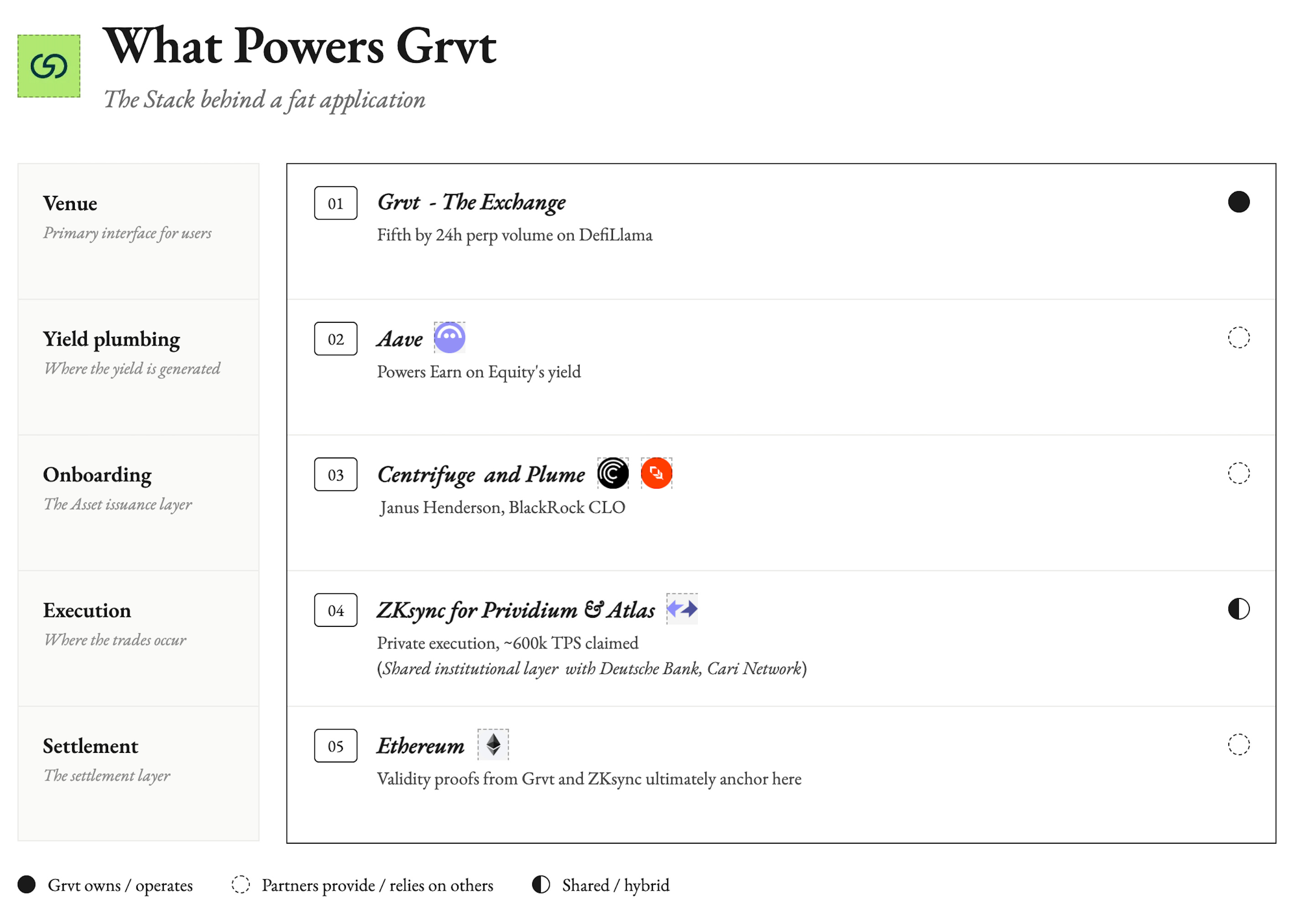
The second part is ZKsync’s use of Atlas. Atlas is ZKsync’s interoperability and performance layer, designed to let ZK Chains communicate with Ethereum and with each other at faster finality. For Grvt, the important point is not that a trader’s balance will immediately talk to every institutional chain. It is that Grvt does not have to become a liquidity island. A user can trade in a private, high-throughput environment while the collateral and yield layer can eventually connect to Ethereum DeFi, tokenised funds and other ZKsync-native chains.
That matters because Prividium allows institutions to run their own private chains while still settling proofs back to Ethereum. Deutsche Bank’s DAMA 2 work with Memento uses ZKsync Prividium for tokenised fund management. Cari Network, a consortium of US regional banks, is using Prividium for tokenised deposits. ZKsync materials also reference the ADI Chain for sovereign-grade settlement infrastructure.
Atlas is what makes this ecosystem relevant to Grvt. If these chains can interoperate, then Grvt can become a venue where capital moves between trading, yield, and tokenised financial instruments instead of remaining trapped inside a single exchange. This philosophy is fairly different from what we see in traditional exchanges. The focus is not on having users trade more but building on infrastructure that can speak to a broader universe of assets.
In six months of interacting with the team, we observed a simple trend in where their focus sits. The obsession is not building yet another decentralised exchange that competes only on volume. Hypergambling does not work as a long-term business model because it leaves users worse off. Grvt’s focus has instead been on making new-age assets and primitives accessible to the average user without requiring the balances a conventional prime broker would expect. It has logical business reasoning too. The market for wealth-preserving products is not yet saturated, with over fifty players offering the same pitch of “get rich with crypto”. The cost of acquiring new users is drastically lower than a new exchange, where the primary focus is on speculation: larger TAM, lower CAC.
How does Grvt address these needs? For starters, consider that the average person does not sit online trading constantly. There is a market for that kind of product, but it is far smaller than the market for users who want a place to park their money, earn yield, trade the occasional narrative, and have access to their capital when they need it. Credit funds like the ones Blue Owl offers are not available to retail depositors if they have less than $100k. When they do need access to these funds for a personal emergency, the fund has the right to charge heavy withdrawal fees.
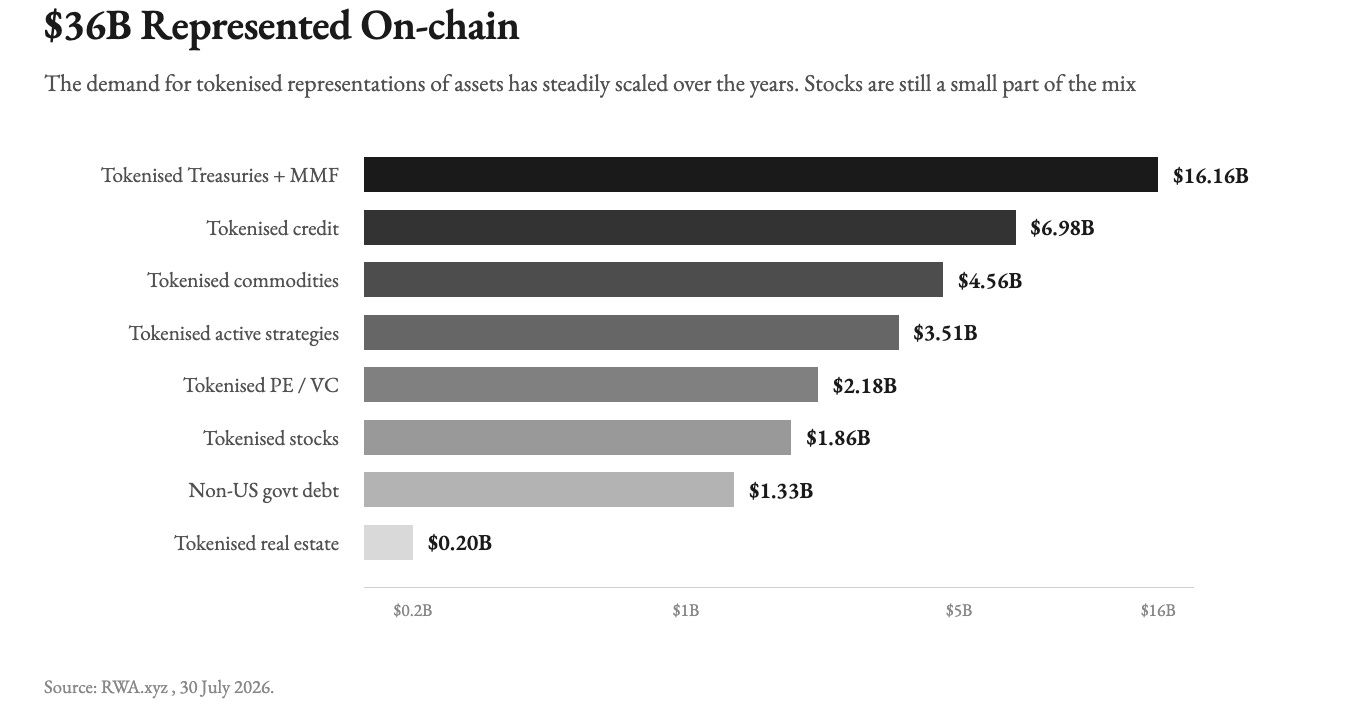
At the same time, these instruments are emerging on-chain at a rapid pace. Tokenised stocks are now available from Ondo. DTCC itself is considering native tokenisation of equities. As demand for AI-linked stocks from around the world increases, both awareness and demand for regional equities instruments will surge. Perpetuals and tokenised variations of equities are perfect for the world to buy into these waves. BlackRock, Apollo, and Franklin Templeton are in on the madness too. They have variations of money market funds and credit funds available on-chain today. According to RWA.xyz, there is roughly $1.4 billion of tokenised stocks, $14.6 billion of tokenised Treasuries and money market funds and $5.8 billion of credit represented on-chain. This excludes the trillion-dollar economy that stock perpetuals themselves have become in the past quarter.
A user from anywhere in the world can buy them for as little as $1 and receive yield on their capital. They also get to loop it on avenues like Morpho for additional yield.
We are witnessing a rapid expansion of the nature of assets that are available on-chain, and the unlocks it can offer users. But the marginal person is not looking to loop BlackRock’s securities fund on Morpho for a few extra points. They are not close enough to the ecosystem to track these shifts. The more important part here is that yield itself is commoditising. The moat is in distribution - or the sheer number of users a product can attract. And in how that capital base generating yield can speak to other product lines within the same product. We call this composability within our industry. And that is what Grvt has been focused on.
Why is that the case? A study of day-traders who traded consistently for more than 300 days in 2020 clarified that 97% of users lost money. Prediction markets are all the rage today, but 70% of the users on it lose money. The top 1% of users on Polymarket are responsible for 76.5% of the profits generated on it.
The average person on the web is not trying to escape the permanent underclass no matter how you cut the numbers. The TAM does not expand with better casinos.
These users instead park their money into the money market funds that are available on Grvt. The same funds can be used as equity to trade the occasional semiconductor stock or meme coin rally on the same platform. This blurring of worlds - between that of storage of wealth, access to tools to beat inflation and trade hot markets is what makes Grvt’s positioning unique. The way it works is rather novel - and it entirely relies on composability.
As of writing, the platform allows users to trade over 43 tokenised equity pairs - some of which include Korean equities that have been all the rage - alongside commodities like gold and crypto majors.
When a user parks money on Grvt for collateral, it is auto-converted into a yield-bearing instrument through the Earn on Equity product. Traditionally on an exchange, equity does not produce yield. The $100 you park to trade Bitcoin sits as $100 until you get liquidated or close a trade. Grvt allows users to earn yield on it. Earlier this year, they launched Aave as an integration so you could also verify where the yield itself came from.
For users that do not care to trade, Grvt also launched Grvt Invest. Instead of building these instruments in-house, they got Centrifuge and Plume involved. Centrifuge is responsible for onboarding the Janus Henderson Anemoy Treasury fund. Plume provides tokenised treasuries and BlackRock’s AAA-rated CLO ETF.
These instruments can also be used as collateral in vaults on exchanges. On Hyperliquid and Lighter, users park money in vaults to provide liquidity for trades. In exchange, they receive yield. Hyperliquid’s vault has $266M in TVL and has generated 12% APR. On Lighter, the APR is closer to 11%. The problem with such vaults is that they carry material risk. A vault takes on directional, market-making exposure depending on the market it is active in and can erode depositor capital during sharp moves.
The approach Grvt takes is interesting for two primary reasons.
They use tokenisation and composability as a wedge to offload the challenges of finding yield. Centrifuge is better suited to onboard Janus. Plume already has the BlackRock instrument on-chain. These are secure, stable instruments with regulatory cover. So instead of reinventing the wheel, they created demand for these instruments.
They also focus on giving users the ability to stack sources of yield. Yield can be competitive and high depending on the risk a user wants to expose themselves to. A user could park dollars and receive yield. Or buy into a credit fund to take some more risk. As of now, a user cannot provide capital into a vault, have margin, and earn yield all at the same time on most avenues. Grvt is working towards that vision by Q3.
Ultimately, the beauty of Grvt is that it can use blockchain rails to give access to niche financial products at a global scale through a permissionless mechanism with verifiability. If perpetuals were the embodiment of what makes blockchain rails an ideal capital movement technology, Grvt takes it one step further by using composability and tokenisation to build a product that goes beyond speculation. In an industry that focuses on having traders bet increasingly more, Grvt looks at how to help users retain more of their wealth and expand access to the instruments they can get hold of.
In many ways, this is symbolic of where crypto is. The tokenisation and protocol layer have reached maturity. What we are seeing now is a layer of fat apps that plug the best instruments and curate markets in applications. Such products will focus on distribution, curation, and retention as moats. In many ways, this rhymes with how wealth management in the traditional finance sector itself has evolved over the years.
When Everything is Tokenised
Crypto-native products have traditionally had a singular focus: to make users trade as often as they could, because the fee came from the transactions. If the broad arc of finance has a single message, it is that eventually you want to be the banking layer for the end consumer. The LTV of a user is substantially higher if the user parks their wealth within the product. Offering mechanisms to generate yield and access tokenised equities was not a possibility in 2022.
That reality has since changed. Grvt is the first of many products we will see transitioning to what I consider the “slow finance” phase of crypto. Or, in simpler terms, the coming of age.
In February, long before the yield-based products on Grvt were launched, I had a chance to speak to the founder, Hong Yea, about why any of this matters. The simple answer is that the market that seeks to store capital, access capital market products, and diversify asset bases while remaining self-custodied is substantially larger than the one for constant speculation. Cracks in equity markets are already visible today, with the KOSPI Index dropping as much as 12.6% on the 29th of July. We routinely see semiconductor stocks like SK Hynix and Samsung Electronics crash by close to double digits in a day. Having users hyper-gamble sounds like good business in the short run, but it does not lead to products that retain users.
More critically, there is another reason to build a retail user base for new money market instruments. Hong said conversion of users referred to the product jumped from 7% to 45% once the pitch shifted from trading to yield. Most people already understand the fixed interest rates their banks offer, so adding a few percentage points on top is an easy sell. Even then, Hong and the team may not earn most of their revenue from end users buying these instruments, but from issuers. Firms like Franklin Templeton and Blackstone have an incentive to pay Grvt for distribution of tokenised products once it reaches sufficient scale. Rather than relying on predatory tactics to push gambling products, Grvt is aiming to build the distribution layer that lets it work with the best asset issuers over time.
The distribution edge became more evident when I spoke to Ganesh Mahidhar from Further Ventures about their cheque into Grvt. His perspective is that Grvt has the opportunity to earn the entire stack for money. Users will be able to pay (via a debit card), access loans, earn yield, and access niche assets like computing derivatives on the same avenue. For tokenised asset issuers and mutual funds, the upside is access to a new distribution channel that, until 2024, did not exist due to the prohibitive costs of distribution, compliance, and servicing a customer at a traditional bank.
None of this is new conceptually. Crypto has pitched yield as a differentiator since at least 2018. For example, when crypto.com marketed higher-yield products in Singapore. What is different now is that the infrastructure has matured enough to support products like Grvt. Grvt is built on ZKsync and pairs that with its own risk engine for the markets it operates. ZKsync, in turn, can connect across multiple chains, where the on-chain “real-world asset” spectrum now ranges from stablecoins to tokenised real estate.
In that sense, the next big battleground for crypto applications is shifting away from base infrastructure (as it felt in 2022) and toward distribution, retention, and the business models that capture value over time.
The age of fat applications is here. This time, instead of being built centrally, with applications taking custody of user funds as FTX did, users have the option to hold their own assets. Even when they move capital into tokenised yield instruments, if Grvt goes down and the assets remain in their wallet, they can use a third-party interface to swap back into stablecoins. Grvt’s moat comes from its risk engine, brand, and distribution. Since the marginal user coming to Grvt is not a crypto-native trader looking for the 50th yield farm, retention should be structurally stronger.
It is rare for multiple primitives to mature at the same time in a way that enables a new product category. For Grvt to exist and scale, perpetuals had to be in demand, ZKsync had to mature, and tokenised instruments had to evolve simultaneously. The last comparable wave was when centralised firms were racing to offer yield, and FTX competed on a better perpetuals product. The primary difference this time is that we get to see these products built with radical transparency and self-custody. To me, that seems like a massive win.
Perhaps the pull of Gravity is not toward more speculation, but back toward financial sanity.
Playing with a fleet of agents,
Joel John