
Dollars Are a Technology
Exporting American Institutions

This article was originally inspired by a note Marc from OMVC had sent us. He argued that stablecoins solve the orchestration layer and not the dollar scarcity layer. Dollar scarcity is the unsolved problem, which is the deeper one, and using stablecoins doesn’t solve that. You need to inject USD liquidity into these markets
This piece builds on his perspective. I take a look at a handful of startups that are building the orchestration layer for global finance atop blockchain rails. My observation is that blockchain rails will become infrastructure for the export of American institutions and assets around the world. The piece today lays out a thesis for why that could be the case. This is one of a series of notes we plan on releasing on how our internal thesis around crypto and blockchain rails will evolve from here on.
If you are a founder, we’d love to chat. Join our community here.
In the opening chapters of The Splendid Exchange - there is a reference to Herodotus’ account of silent trade between Carthaginian merchants and an unnamed Libyan people on the western coast of Africa. The Carthaginians would arrive by ship, unload their goods on the shore, return to their vessels and make smoke. The locals would then come down, inspect the goods and leave gold beside them. If the Carthaginians felt the price was unfair, they would simply wait for the buyers to leave more gold at the coast. This would repeat until both parties had a mutually agreed upon price. There would be no words exchanged, but there was a shared language.
This was 2500 years back - before World Bank, SWIFT, blockchains and perhaps, most civilisation. All these years later, commerce has been the same. An attempt at exploring shared languages to find fair price. The price, in market terms could be what we consider interest rate, forex costs or the dollar amount to be paid. But all commerce has been an attempt at creating a unified, shared language.
Organisations like the World Bank and the IMF helped create a shared institutional language for sovereign finance. SWIFT did the same for banks communicating across borders. Visa, Mastercard and the DTCC extended that grammar into payments, cards, clearing and settlement. For over 70 years, global commerce has relied on institutions that make strangers legible to one another because part of what maintains global peace is commerce.
If your economy relies on a nation conducting business with you, odds are quite low you would want to bomb them. Intertwined economies, by extension often lead to periods of lower conflict. But these institutions are restricted in their ability to enforce trust. The trust - is codified in legislation, banking relationships and operational processes, but neither verifiable, nor enforceable through a shared technology.
Perhaps a global ledger that is constantly validated by all parties involved could lead to a better solution.
Visa realises this. Mastercard realises this. The DTCC realises this. Even SWIFT realises this. The adoption of blockchains in its different forms is fuelled by a desire to create a shared language for global-scale commerce. We have been operating internally with a simple thesis. The idea is that - blockchains are about to do to capital market assets, what the web did to information. The marginal cost of access will diminish to zero, verification will become faster and the globe will turn into a single capital market.
Tokenisation is an attempt at creating shared languages for the world’s economies to speak to one another. But the assets that move through this language are only as strong as the institutions backing them. An economy is aided by strong institutions that know to balance risk (through interest rates) with balancing the interest of its people (via regulations). America stands out as a nation with strong institutions that allow technology to be developed, exported and capitalised effectively. Silicon Valley may not exist elsewhere, if it weren’t for the capital markets and the nature of institutions in the United States. Delaware is where the world’s startups incorporate because it has access to both capital and the institutions that make these startups possible.
Dollars are a mechanism for the world to benefit from those institutions. Stablecoins, by extension, are an export of the stability American institutions offer its own people. Tokenisation is the grammar that enforces this shared language. The numbers back my claim.
Total stablecoin supply today is at roughly $315B. Tether alone has roughly $141B in direct and indirect exposure to US Treasuries, ranking 17th overall among global holders of US government debt, above South Korea and the UAE. In February 2026, stablecoins settled $7.2T in a single month, surpassing the US Automated Clearing House (ACH) network for the first time. The world’s economy is coming on-chain. Tokenised equities, credit and vaults are how that transition occurs.
As we stated in this post - blockchains allow fintech applications to turn into full-scale platforms.

That means developers from around the world would soon be able to build products to cater to users using the assets offered by these fintech products.
In Robinhood’s case, that is access to tokenised stocks and real-world assets (RWAs).
In Centrifuge’s case, it is access to tokenised AAA-rated credit through products like JAAA.
BlackRock’s BUIDL does the same for money market funds, while
Ondo is bringing public securities on-chain.
Apollo and Hamilton Lane are bringing private credit and private market funds on-chain through Securitize.
Superstate is building for public companies to issue and trade shares on-chain.
You can even buy access to Blockchain Capital’s tokenised venture fund on-chain.
But users are not onboarded to them directly. Dollars are the hook for most emerging markets. Exporters, freelancers - practically anyone in an emerging market earning in dollars quickly realise they have an instrument that has three functions - all desirable
the asset is inflation proof compared to local currencies. simply holding dollars translates to more capital over time
the asset can speak to global capital markets through hyperliquid, tokenised stocks and meme assets
it is also highly mobile and can be sent anywhere in the world at the click of a button.
In many emerging markets these dollar representations can trade at a premium. In stressed markets and specific periods, that premium has reached 10-15%. The businesses that are able to speak to flows from regional economies and translate it to global ledgers will prove to be tremendously valuable. These businesses take context from regional institutions and make it legible to the globe.
It is a repeat of the web. Google Maps mapped out the world’s streets. Your social feed mapped out its culture. Now a new crop of products map out where assets originate and flow.
We are witnessing several startups tackle this in unique ways.
Key To The Rail
Export and import is the most frequent form of communication between nation states. Swift is the messaging layer atop which that communication occurs. But depending on the region, the pace at which transactions clear can widely vary. If you are an importer in Nigeria, buying from China, your vendor may demand 60% of the payment upfront in dollars.
But the dollars are often not readily available. Nation states restrict access to dollars to maintain their own currency reserves. A USD wire to China - assuming you have the right relationships, at the right banks, with the right amount in bank balances, can take anywhere between 7 to 10 days. And in most cases, people do not have access to all three.
If a vendor in China takes the payment in stablecoins, they forego tax rebates worth up to 13%. So you have two economies where people do want to talk to one another in trade, but the rails do not facilitate it. Part of the reason is documentation challenges, the other is risks with fraud and the last is the challenges in litigating across economies if something goes wrong.
Keyrails comes in less as a lender and more as a payments-and-credit orchestration layer for such transactions. It does not lend from its own balance sheet. Instead, it acts as a clearing house that connects importers with external capital providers - non-bank financial institutions (NBFIs), fintechs and, more recently, on-chain vaults - while controlling the payment path through which the borrowed capital can be used. Lenders earn roughly 15-20% APR, while borrowers pay 20-25%. Keyrails keeps the spread of around 2.5-5%, alongside fees from the payment rail.
Keep in mind, this is the borrow rate, not the conversion rate, which is the parallel alternative for most importers.
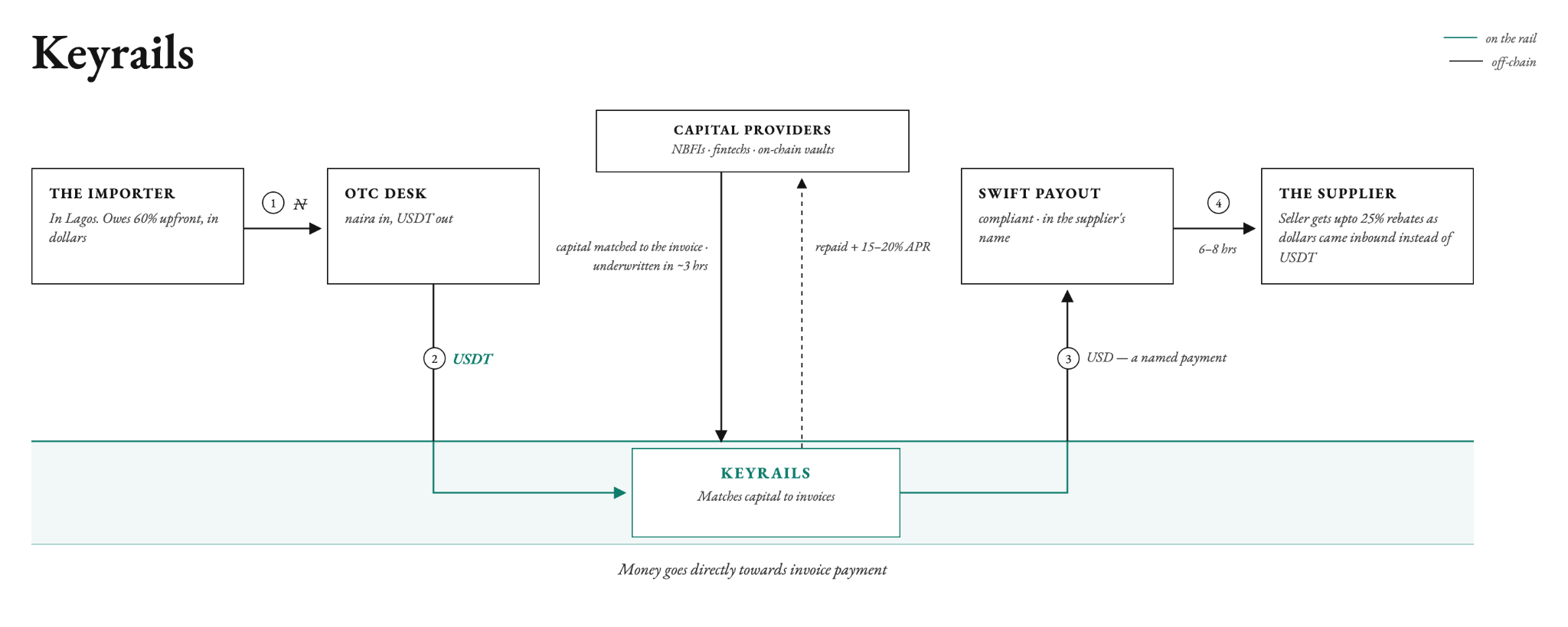
Keyrails absorbs Naira in the form of USDT, once it is converted at a regional OTC desk or exchange. Keyrails then forwards payment to the supplier through its SWIFT rail. Lenders pull three months of trading history via API and underwrite the loans in around three hours. The money never goes to the borrower. Instead, capital is matched directly against the seller’s invoice and settled in China through SWIFT.
The math works because the borrower is comparing Keyrails against the parallel-market FX premium, not against a cheap bank loan that does not exist. If, during stressed periods, the status quo costs 20-30% in currency conversion premium and takes 7-10 days to clear, a 20-25% APR facility that settles in six to eight hours can still be cheaper, especially when the loan tenor is short. At a three-month tenor, a 20-25% annualised rate implies roughly 1% interest for the period, before fees and collateral effects. That is materially lower than paying a 20-30% FX premium upfront.
For the seller, the benefit is equally straightforward: dollars arrive directly in their bank account as a compliant named payment, preserving access to local tax rebates that stablecoin settlement would not provide. Part of the reason is the lack of liquidity around these currency pairs in emerging markets.
In this case, Keyrails’ primary value is not that it has the cheapest capital. Its value is that it controls the rail that makes the lending safe. It standardises how trade data is gathered digitally, creates payment rails across countries, and restricts capital within its ecosystem so borrowed funds can only be consumed against real invoices. Its moat is the combination of underwriting data, compliant settlement and use-restricted capital. With each transaction, the system becomes better at making regional trade flows legible to global dollar capital.
Programming Credit
We noticed one of our own portfolio companies focusing on a different part of the equation. Keyrails focuses on making money move faster between unorganised sectors. Semiliquid provides infrastructure for collateral to stay stagnant, between known counterparties that share collateral.
The shared idea is containment. In Keyrails’ case, funds can only leave through a permitted payment rail. In SemiLiquid’s case, the asset does not need to leave custody at all.
Tokenisation by itself only changes how an asset is represented. It does not automatically make the asset useful as collateral. If a bank, fund or trading desk holds tokenised Treasuries, money-market funds, equities or credit instruments with a custodian, the asset becomes far more productive if it can be borrowed against. Without margin, a tokenised asset is mostly a digital wrapper around something that already existed. With credit, it becomes part of a larger financial machine.
SemiLiquid’s Programmable Credit Protocol (PCP) allows borrowers and lenders to finance tokenised instruments without moving them out of custody. The borrower keeps the asset with the custodian and can continue earning the underlying yield. The lender receives an enforceable claim over that asset. If the borrower repays, the lock is released. If the borrower defaults, the lender can take control of the collateral according to pre-agreed rules. The useful phrase here is delivery-versus-lock: cash can move, but collateral stays where it is until it needs to be enforced.
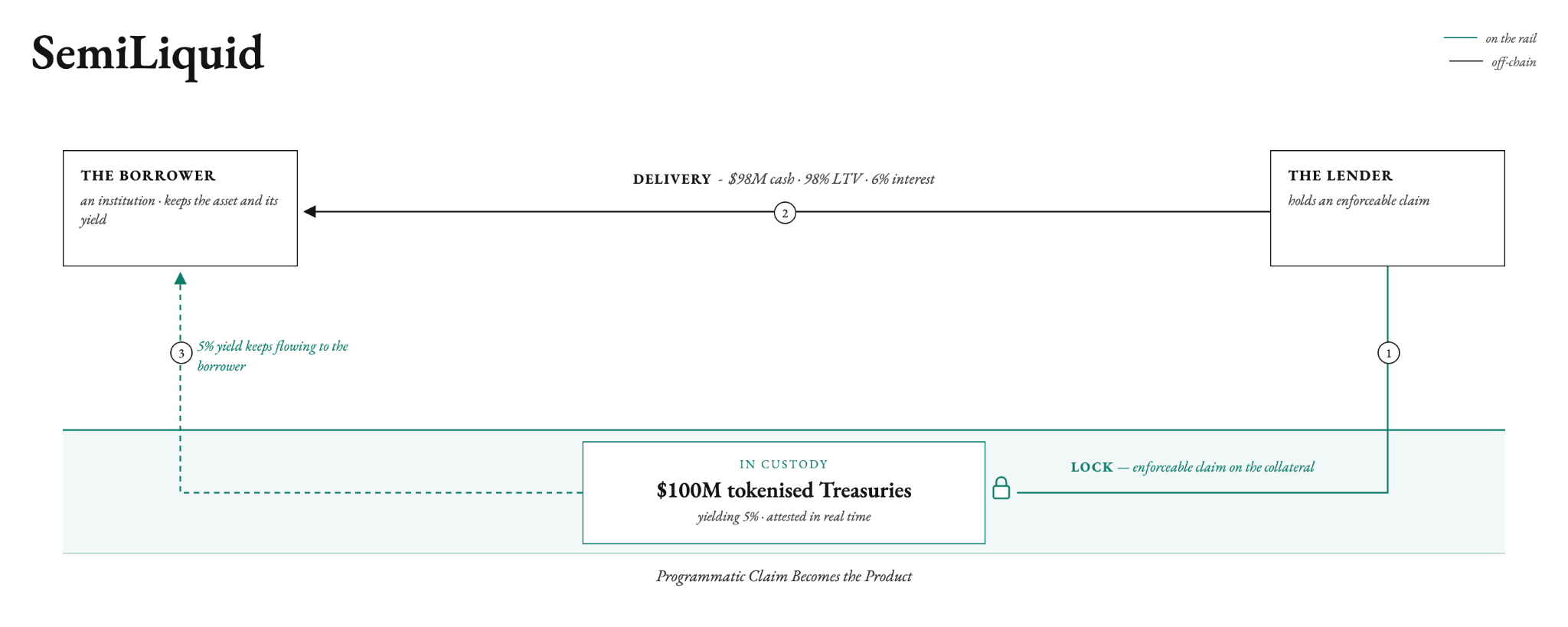
Consider the math at play. Assume an institution holds $100M of tokenised treasuries yielding 5% annually. If it borrows at 98% loan-to-value (LTV), it can access $98M of liquidity without selling the underlying asset. At a 6% annual borrowing rate, the headline interest cost on the loan is $5.88M per year. But if the Treasuries continue earning 5%, the collateral generates $5M in annual yield. The borrower’s net cost is therefore roughly $880K, or about 0.9% of the $98M borrowed, before protocol fees, haircuts and any custodian fees.
The borrower is not simply paying 6% to borrow. They are paying the spread between the cost of debt and the yield retained on the collateral. In a traditional setup, that yield may be eaten by the bank or custodian. With programmable collateral, the asset can remain locked for the lender while the yield still flows back to the borrower. SemiLiquid is bringing this logic to a broader network of tokenised assets and institutions that want to lend and borrow against one another.
The difference is in the assets involved, the speed of underwriting, and who gets to keep the yield.
This is different from a DeFi lending market like Aave. Institutions do not have to move assets into an open smart-contract pool, accept public liquidation mechanics, or price in the risk premiums that come with permissionless lending. They can keep assets with regulated custodians while still making those assets financeable. For lenders, the upside is faster diligence and cleaner enforcement. The custodian can attest to the state of the collateral in real time, while the protocol prevents the same asset from being pledged twice inside the same rail.
One way to understand why this matters is through collapses like Three Arrows Capital and Archegos. 3AC left creditors with roughly $3.5B in claim. Archegos created a similar blind spot in traditional finance: Bill Hwang’s family office built overlapping swap exposures across multiple prime brokers, and Credit Suisse alone lost about $5.5B when the unwind came. In each case, the problem was not just that prices fell. It was that lenders did not have a shared, real-time view of what collateral existed, where it was pledged, and whether the same balance-sheet strength had been represented to multiple counterparties.
SemiLiquid tries to replace that trust gap with real-time collateral verification. The loan does not need to be publicly visible to the market, but the relevant parties can know whether the collateral exists, whether it is locked, and whether it can be enforced.
Traditional secured lending often requires lawyers, back offices, custodians and manual reconciliation to coordinate around a single financing transaction. SemiLiquid compresses that process into programmable credit infrastructure. More importantly, it turns idle tokenised assets into collateral that can support borrowing, margin and repo-like activity. That matters because the next phase of tokenisation will not be about putting assets on-chain. It will be about making those assets useful enough that institutions can earn a few extra basis points, borrow against them, and use them without giving up custody.
Eating the $Chip
GPUs are the heart of the AI economy. They are what compute the answer when you prompt endlessly on a Thursday afternoon. They also cost a lot, which is why Meta, Amazon, Alphabet and Microsoft spent roughly $410B on capex in 2025 and plan to spend roughly $725B in 2026, an increase of around 77%.
In simple words, GPUs are what tractors would have been in a world where agriculture was the primary source of income: productive machines that convert capital expenditure into recurring output.
Firms take lines of credit to buy GPUs on the assumption that the hardware will generate revenue from third parties leasing compute. But data centres and smaller AI infrastructure companies often do not have access to the same low-cost capital as Google, Amazon or Microsoft. It is an underserved part of the market where even calculating loan terms is difficult, because the price, cost-effectiveness and residual value of GPUs can change as models become more efficient and enterprise demand evolves.
As of writing, USD.AI has roughly $398M in total value locked (TVL), with about $202M deployed in active loans. Loan sizes have grown from $1-5M at launch to a $98M facility against a 2,304-GPU cluster - the collateral model scaling well past pilot size.
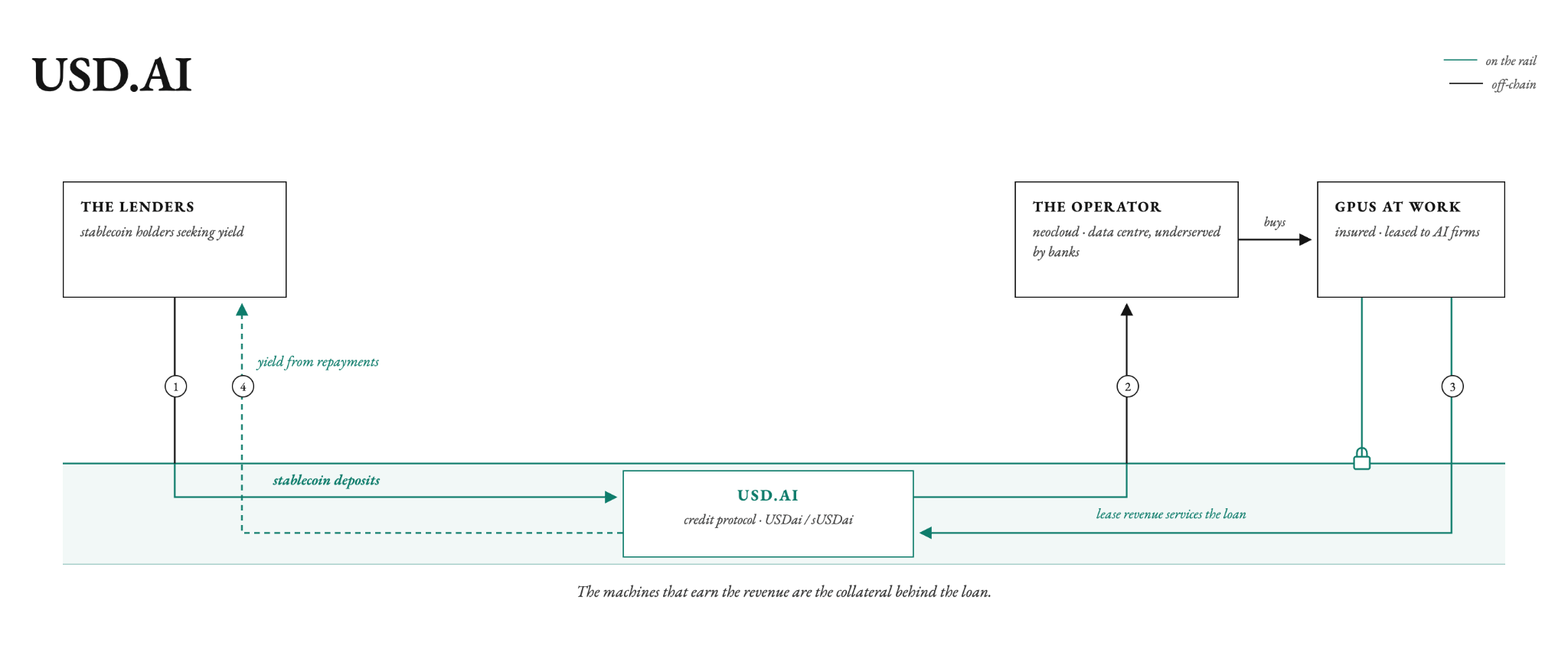
Lenders on USD.AI get access to a market driven by hyperscaler demand and AI compute growth. Borrowers on the other hand benefit from financialising an existing asset in hand, without needing to find traditional lines of capital. All while having faster access to money. Both parties benefit from the fact that the GPUs can be financialised in the form of collateral in the event that something breaks.
USD.AI’s core customer is not the data centre alone. Or a startup. Or a hyperscaler. It is anyone interacting with the GPU economy. Its value is in creating a liquid lending market around an asset that is productive, physical and hard to finance. And that underwriting takes years of expertise because a single bad loan can question the legitimacy of the entire market. In other words, they are taking GPU-native context and translating it to a global liquidity pool that seeks to lend against it using stablecoins.
Context is Where the Dollars Are
Each of these businesses look very different from what we used to consider “DeFi”. They use tokenisation, blockchain rails and stablecoins to accelerate markets that were traditionally underserved or disorganised. The moats in these products do not come from code alone, but from deep, enriched context that comes from each transaction cycle on the product. A loan on SemiLiquid’s PCP, a borrow on USD.AI’s CHIP and a transaction on Keyrails are similar in that, with every transaction, the platform generates trust and credibility that is hard to replicate. It also gives these businesses a way to double-check their own processes.
The value in these businesses will not come from transaction volumes alone, but from the context they build on the users, borrowers and counterparties of their products. This is very similar to how banks work. A bank can derive more value from each marginal customer in the form of a credit card, mortgage or fixed income product the longer the customer stays with the bank. In turn, these businesses manage to escape the cyclical seasonality that comes with crypto. Unlike exchanges or trading products, the demand for export-import, loans and margin is steady and applicable across the economy.
In other words, this is how crypto grows beyond trading and speculation into the operating system for real-world capital formation.
Commerce needed a shared language. Tokenisation gave us words that are accessible, easily relayed and transferred. Protocols give us the grammar to enforce it. Startups that contextualise and onboard the world’s markets to this shared culture of transaction will capture the next decade of value.
Exploring Token Aggregators,
Joel John
America's energy relationship with Canada is about much more than oil.
Canada has been one of the United States' most important energy partners for decades. If Canadian producers increasingly look toward Asian markets, particularly China, the issue is not simply that America is “losing energy.” The bigger concern is what happens when trade relationships, infrastructure, and geopolitical interests begin to shift at the same time.
For Canada, finding new customers can provide economic diversification and reduce dependence on a single market. For the United States, it is a reminder that even close allies have their own economic priorities.
The answer should not be panic.
It should be resilience.
Reliable energy + modern infrastructure + competitive markets + strong alliances + diversified supply = energy security.
North America has an enormous advantage: geography, resources, infrastructure, skilled workers, and deeply connected economies. The challenge is turning those advantages into a long-term strategy rather than allowing short-term political disputes to weaken them.
The real question isn't “Is Canada choosing China over America?”
It is:
Can North America build an energy system strong enough that its partners have the freedom to diversify without turning economic diversification into geopolitical conflict?
Energy security ultimately depends not only on what a country produces, but on the strength of the relationships, infrastructure, and institutions connecting it to the rest of the world.
The USD.AI number here — $398M TVL scaling to a $98M facility against a single 2,304-GPU cluster — is the concrete case for tokenized compute-as-collateral that most "AI x crypto" takes only gesture at.