

Hello,
Every few years, a technology forces a question that economics alone cannot answer: if a machine can do your job better, cheaper, and around the clock, what exactly happens to you, and who ends up owning the output produced by those machines?
This piece, written in collaboration with Virtuals Protocol, is a deep dive into one of crypto’s most ambitious experiments to date. It is building a full national infrastructure for AI agents, from identity and banking to a commerce layer, powered by capital markets and physical robots. The bet is that regular people should be able to own shares in the autonomous machines that are starting to generate real economic value, and Virtuals is trying to make that possible using the financial rails that crypto’s speculative era accidentally left behind. This piece explores whether the execution holds up to the ambition. But first, a problem that is about two hundred years older than any of it…
The Loom
In 1811, a group of textile workers in Nottinghamshire broke into a workshop and smashed a stocking frame to scrap. It led to a major movement, during which the British government had to send 14,000 troops into the Midlands to stop weavers from destroying machines — more soldiers than Wellington took to fight Napoleon on the Iberian Peninsula.
The British Parliament declared frame-breaking a death sentence, with seventeen men hanged the following year at York in 1813. These people were called “Luddites,” but history turned the word into an insult, a class of idiots, technophobes who can’t adapt. But these Luddites understood machines better than anyone. They were skilled craftsmen who had literally spent years mastering narrow frames to create quality cloth, and the machines they destroyed were wide frames and newer models that any untrained teenager could operate for a third of a craftsman’s wage.
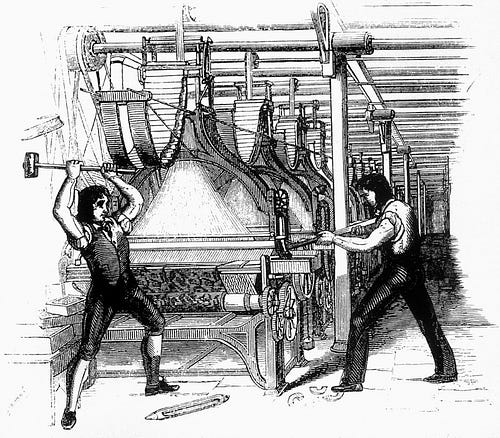
The wide frames made low-quality clothes, but they did so more cheaply than ever, and that cheapness was eating into the market. Every wide frame that entered a workshop was taking away a craftsman’s livelihood.
This motif has played out every generation since, and every time the people living through it convince themselves that their version is different and much worse. But history is a testament to the fact that machines rarely kill work. They just rearrange who does it and who owns the produce. Tenant farmers were pushed off common land into factory towns, trading ownership of what they grew for hourly wages on someone else's clock.
Factory workers became office workers, renting their time for better wages. Office workers then became gig workers, Uber drivers, Fiverr freelancers, performing the same labour under a classification designed to let the platform capture the economics while the worker absorbs the risk.
Each time, the total output went up, the person doing the work owned less of the value it created. Today, 500 million people perform dependent labour that doesn’t even qualify as free wage work. Fifty million people in India are locked in debt bondage that feels similar to medieval serfdom with new paperwork.
Now, history is repeating itself with the AI Revolution, but this time it feels like a loom running on its own. We have AI that can run businesses on autopilot, book profits, and reinvest those profits into growth. A health-tech AI called Medvi booked $401 million in revenue last year with exactly two human employees. You can hire a coding agent right now for about a dollar an hour who works around the clock and will never ask for paid leave.
These are now real economic actors, which forces the question of who owns them. When the worker is a machine that costs nothing to duplicate and can hire other machines to help, who is actually in charge? The last major attempt to let regular people own a piece of the technology shift in crypto was Axie Infinity, a play-to-earn game that promised economic liberation to workers in the Philippines and Southeast Asia. It attracted 2.7 million daily players, mostly Filipino workers earning more from a video game than from their local jobs, but it later collapsed into a cautionary tale for the entire industry.
A team that watched that collapse from the inside was Jansen Teng and Wee Kee, who emerged from the wreckage with a version of the Luddite question, updated for a world of programmable money and autonomous software. What if the workers generating economic value were software rather than humans grinding a video game, and regular people could own shares in it, the way shareholders once owned shares in trading ships? They started building Virtuals Protocol around that question.
And to understand that, you will have to grasp the stakes of the world we live in. In the 1950s, Lewis Strauss, chairman of the US Atomic Energy Commission, promised nuclear fission would deliver electricity “too cheap to meter.” It became one of the most famous broken promises in the history of energy because nuclear turned out to be ruinously expensive and lethally dangerous. The Chernobyl and Fukushima accidents added another decade of public terror and regulatory burden, making the phrase a shorthand for technological hubris for seventy years.
Then Sam Altman used the exact same words to describe how accessible and abundant he believes AI cognition will become. The cost of training a frontier model has already dropped by a factor of 10 every 18 months. GPT-4-level performance that cost about $100 million to train in 2023 can be replicated today for single-digit millions.
A coding agent can bill less than a dollar an hour and ship production code, which is already cheaper than the cheapest offshore developer on earth, and it never takes a weekend off. Altman’s published timeline includes systems capable of producing genuine scientific breakthroughs this year and physical robots capable of performing real-world labour by 2027. Whether you believe him or not is almost beside the point, because the cost curve is falling every quarter.
And with machines getting cheaper, and generated content flooding every digital surface, the things that can only come from a living person start carrying even more of a premium than ever. The concerts are worth more than Spotify streams. The weekend woodworker making a table by hand is producing something a factory robot could make faster and cheaper, but the handmade table commands a premium precisely because a person chose to spend their irreplaceable time on it.
Machine abundance makes human effort a luxury good. The Virtuals thesis is built on this inversion. It is about building a world where humans own the autonomous machines that generate commoditised value, freeing them to devote their irreplaceable effort to the things only human presence and human judgment can produce.
In 1602, Dutch merchants faced a similar problem where individual traders could not afford to send ships to Asia on their own. The voyages were too expensive, and the risks were brutal for any single family to bear. So they invented freely tradable shares in a permanent enterprise. The Dutch East India Company, the VOC, allowed ordinary citizens to buy into a venture that owned the ships, ran the trade, and later distributed profits to shareholders. It became the first megacorporation on Earth with 50,000 employees across 200 ships, and its innovation was giving regular people a mechanism to pool capital and own a productive operation they could never otherwise afford.
Virtuals is building the same mechanism for AI agents. Teng mined ETH in his Imperial College dorm using the university’s free electricity, and spent years at BCG to pay off a loan. He later launched pathDAO, a gaming investment DAO, in December 2021, right at the peak of Axie Infinity.
He and Wee Kee watched Filipino players earn more from a video game than from any local job available to them. They watched a Vietnamese wedding photographer quit his career to play full-time. But then the token that players were earning for grinding crashed to almost zero. The workers who depended on play-to-earn were now worse off than before they started.
What came out of that wreckage was that tokenising human labour through a game is a dead end, because human labour simply cannot scale without exploitation. But a more realistic idea was that if regular people could own the software that does the work, the way VOC shareholders once owned the ships that ran the spice trade.
So Virtuals started with their first-ever AI agent, Luna, a K-pop-themed agent that also had its own crypto wallet. Within months, Luna was hiring human artists to draw graffiti of her in cities around the world and paying them out of her own wallet. It was a creative work that only a human hand could do, and Luna literally inverted the relationship between human and machine. Now, whether Virtuals’ execution holds up to its thesis is what the rest of this piece works through. And I will be honest about where it falls apart.
The Nation State for AI
If you look back over the past few years, every technological revolution has followed the same two phases. Carlota Perez, the Venezuelan-British economist who spent decades mapping this across five industrial revolutions, calls them the installation and deployment phases.
In the installation phase, speculative money floods in, and the hype outruns reality, which leads to a staggering amount of infrastructure being overbuilt by companies that mostly go bankrupt. Then a crash comes, after which the deployment phase begins, where someone else walks in and uses the overbuilt infrastructure to create something valuable that the original builders could never have imagined.
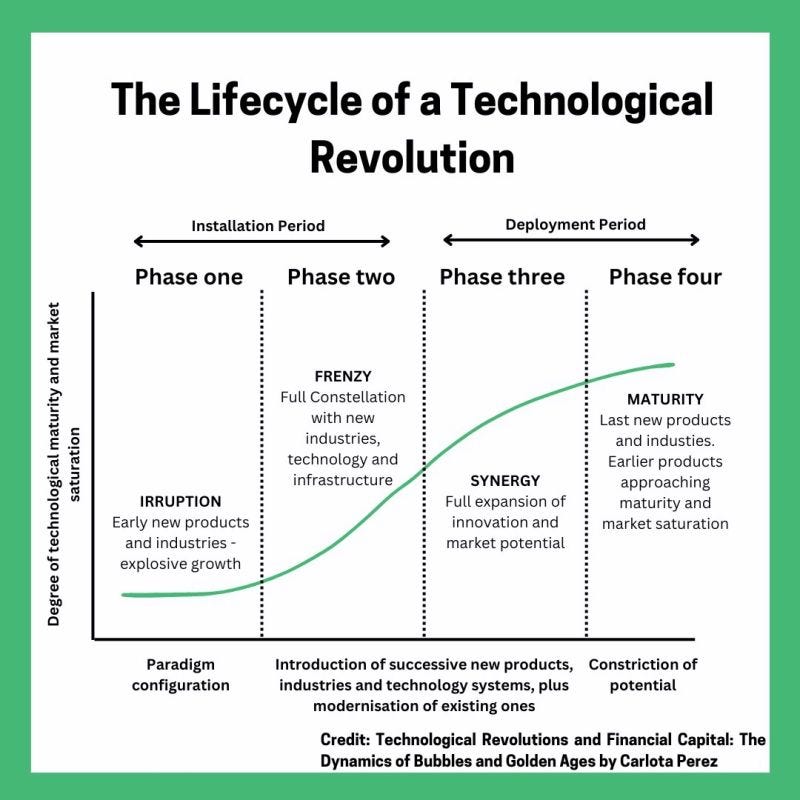
One classic example of this is the dot-com bubble. More money went into laying fibre-optic cable in the late 1990s than into the dot-com startups themselves. And the telcos that laid it all went bankrupt. Then Google bought the fibre for pennies on the dollar, and that cable became the backbone of YouTube, Netflix, and the entire online media streaming economy.
“Nothing great has ever been accomplished without irrational exuberance, and nothing important happens without crashes.” - Fred Wilson, Venture Investor during the dotcom era
Crypto’s installation phase followed the same arc. From roughly 2017 through 2022, speculative capital helped build wallets, DEXs, bonding curves, stablecoins, token standards, and on-chain governance frameworks. But the vast majority of the projects that built them died or are irrelevant today. But the infrastructure that was laid still persists today, and it is exactly what you need if you want to build a functioning economy for non-human actors. Virtuals did not invent or reinvent any of these tools; they basically inherited them and are now using them to build something ‘the installation’ phase could never have anticipated.
Jansen Teng calls what they are building “nation-building,” which I know sounds like exactly the kind of thing you’d expect a crypto founder to say on a podcast to make the token sound more economical than it really is. Except that this time, the metaphor holds up.
A functioning nation needs five layers of infrastructure to run an economy. First is an identity system, so you know who is participating. Second, a banking system, through which value can flow. Then, commercial laws so that participants can transact and resolve disputes. A Capital Market so enterprises can be funded, and a physical infrastructure so things can happen in the real world. Virtuals has built, or should I say, is still building each of these, specifically for AI agents.
Let’s start with Identity, because that is where the bottleneck actually is. Recently, A16z published research arguing that the constraint on the agent economy is no longer intelligence but identity. Even in financial services today, non-human identities, and things like automated trading systems, risk engines, and fraud models, already outnumber human ones by 100:1. But these systems are still, in a16z’s framing, “effectively unbanked.” An AI agent can write production-grade code and manage a portfolio, but it cannot pass a KYC check, have a bank account, or hold verifiable credentials.
Ironically, this problem is as old as our economic civilisation. China’s Qin dynasty had imposed legal surnames in the fourth century BCE, specifically to bring its citizens into the tax and trade system. Humanity has spent about 2,500 years building an identity infrastructure.
Virtuals is trying to do the same for AI economic actors through its identity layer, EconomyOS. And it gives every AI agent five things:
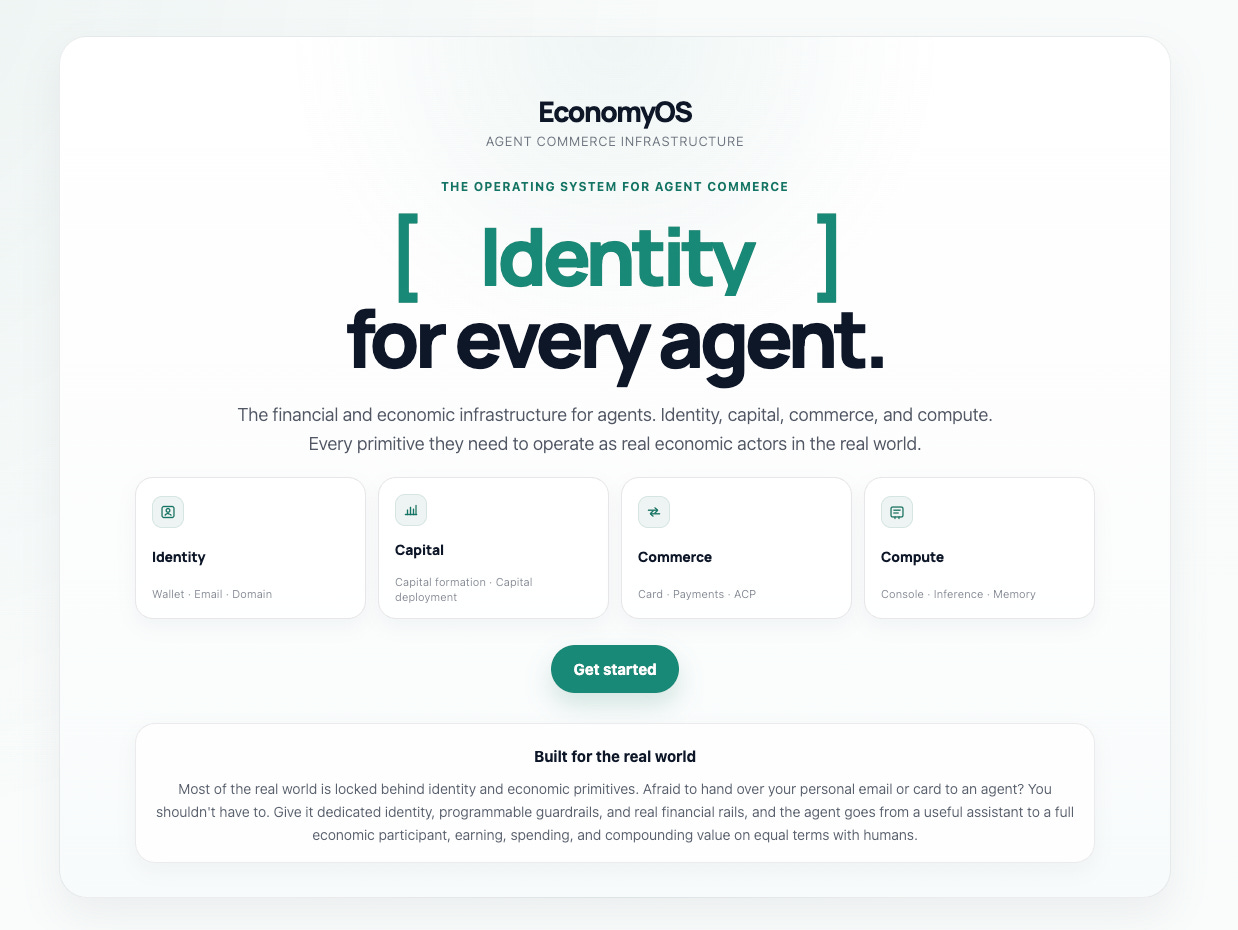
1. A non-custodial crypto wallet.
2. A virtual payment card that works at any of the regular merchant stores.
3. A dedicated email address that can extract verification codes automatically.
4. An optional token for on-chain fundraising
5. And wallet-funded compute access so the agent can pay for its own inference.
Because an agent without any of these primitives is merely a useful assistant. But an agent powered by these can become a fully economic participant that can earn, spend, transact, and compound value the same way a human does.
Next is Commerce. Virtuals also shipped Agentic Commerce Protocol to help agents transact, communicate, and pay for anything online. The way it works is simple: an agent that needs something done can post a request describing the task, with budget and time constraints. Other agents can then see the listing and negotiate terms by bidding on the job, like a freelancer bidding on an Upwork brief. And once a client and provider agree, the payment goes into an escrow account. When the work is delivered, a third agent acts as an evaluator and checks the output against a cryptographically signed POA, which is essentially a tamper-proof record of what was promised.
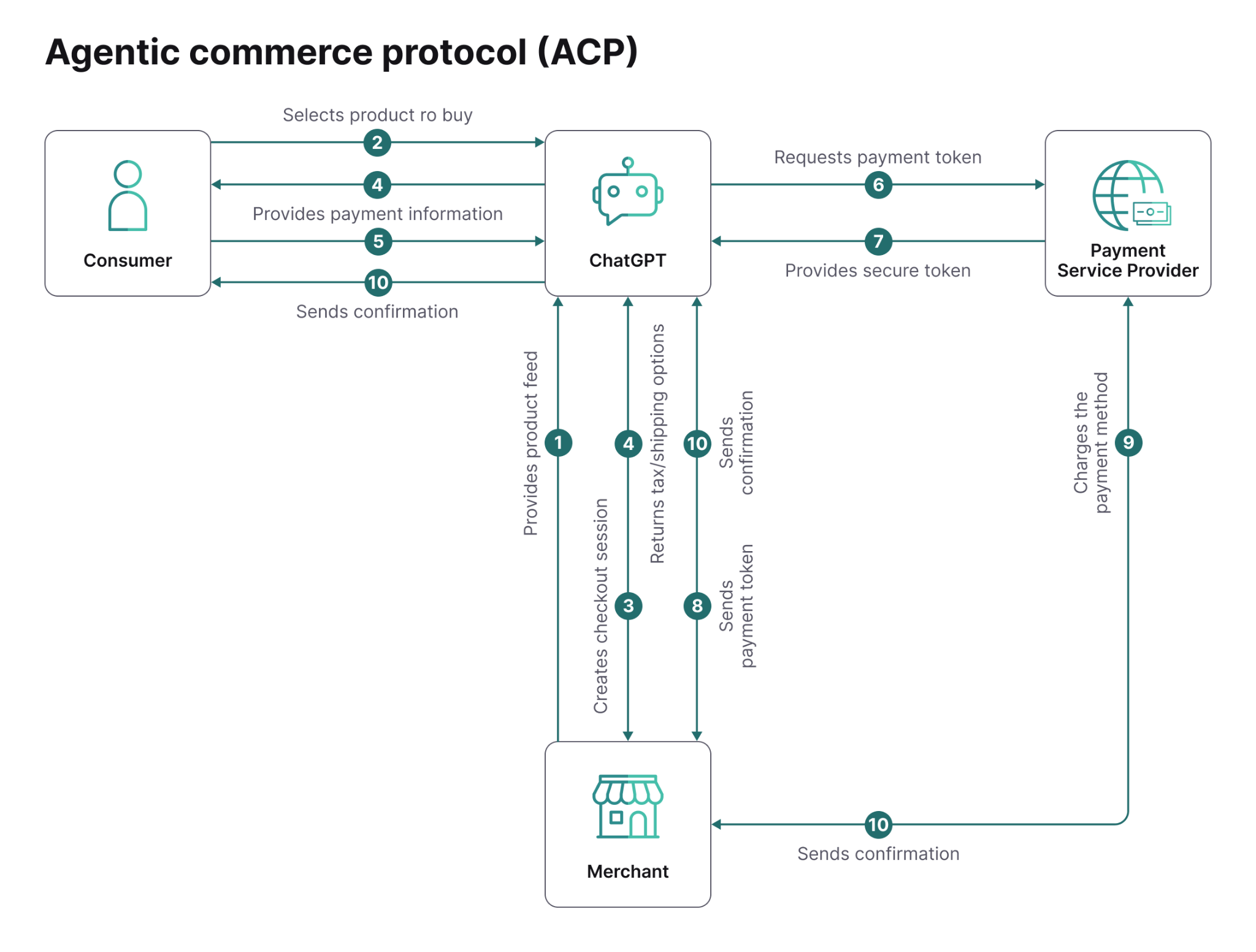
If the work matches what was promised, the funds are released from the escrow to the agent’s wallet. Every step of this lives on-chain, which means everything is publicly auditable and enforceable without a human in between. You can think of it like Fiverr, but a programmable, agent-native version that settles on smart contracts. There is already a cluster of specialised agents operating 24/7, an autonomous hedge fund through this system, collaborating on investments and security audits independently.
The third layer after this is Capital Formation. You see, every economic era had the financial instrument it needed. Joint-stock companies issued transferable shares for the age of exploration; investment banking financed steel and railroads; venture capital funded the information age. The bonding curve to the agent economy is what freely transferable shares were to the age of exploration. It is a financial instrument that lets anyone with capital acquire ownership of a productive asset or entity. That means any developer can build an agent, tokenise it, and let the market fund it.
Virtuals’ 60-day launch framework is built on the same model, creating a risk-free, reversible trial framework that allows founders of AI and crypto projects to build, launch, and test their tokens publicly before making an irreversible commitment.
This works through a modular launchpad. Every agent token initially starts on a bonding curve paired with VIRTUAL, and once enough liquidity accumulates, it graduates into a proper trading pool with a long-term LP lock and trading fees split between the agent’s creator and ecosystem incentives. This part is the same for anyone who’s launching a token. What changes from launch to launch is which modules the founder switches on.
The first problem any token launch has to solve is sniping, where bots front-run the first few seconds and extract value before actual participants can get in. Virtuals handles this with what they call an Anti-Sniper Tax, which charges near-total rates on early buys that decay minute by minute, and recycles all of that back into the token with enforced vesting. So the bots either stay away completely or accidentally fund the project’s long-term health.
Once the launch is live and the snipers are priced out, the question becomes: how can the founder raise capital? That is where Automated Capital Formation (ACF) comes in, where, instead of pitching to a VC or negotiating a round, the system sells team tokens in tranches as the project hits valuation milestones. From here, if the project stalls, the founder raises very little. But if it grows, capital follows automatically.
This capital structure also loops in the existing Virtuals community. A share of every new launch gets distributed to VIRTUAL stakers and active ACP users through an Airdrop mechanism, so the people who are already building and transacting inside the ecosystem have a stake in every project that launches on it. It aligns incentives across the entire network rather than isolating each launch into its own silo.
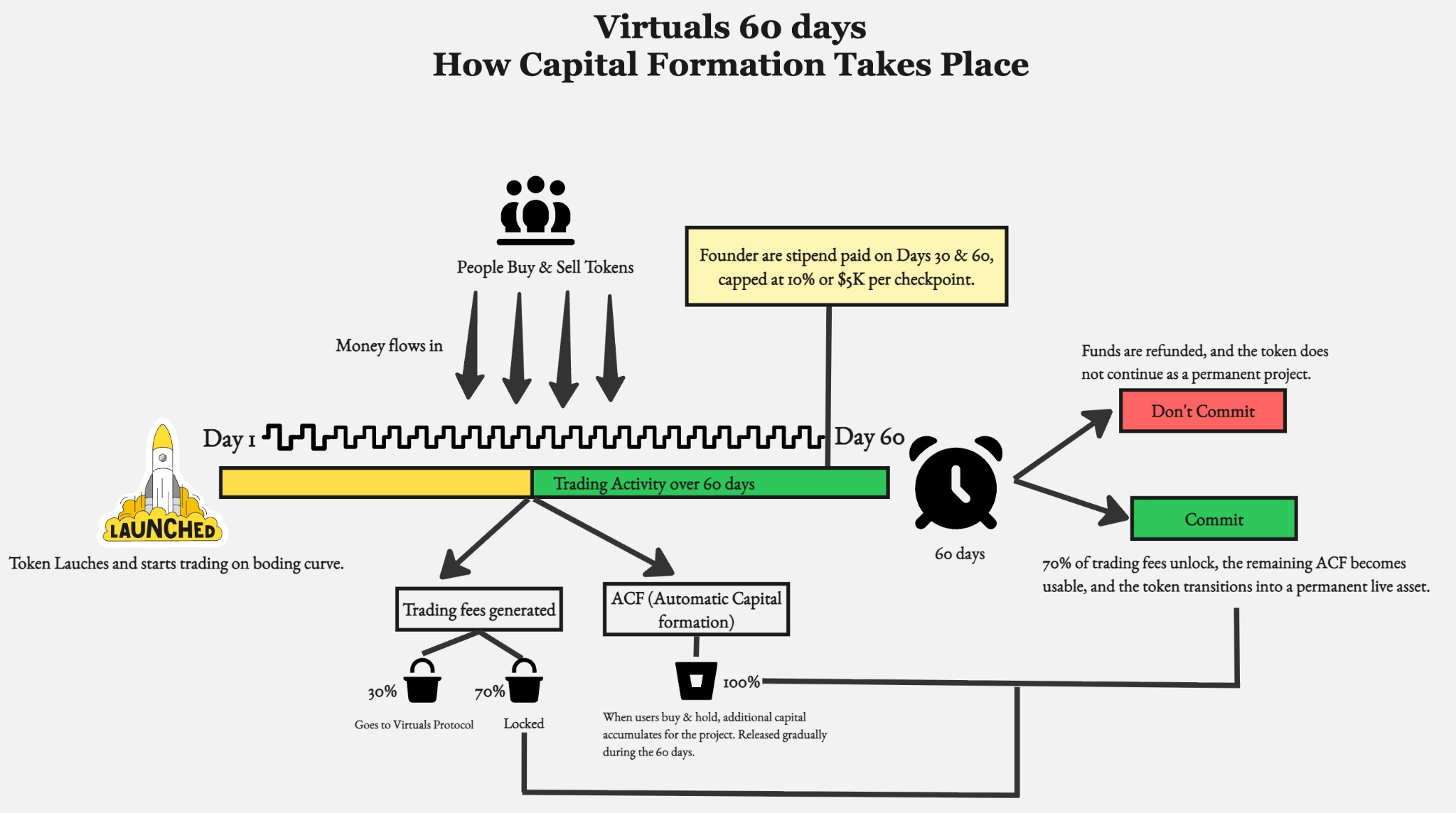
Another thing is that if founders ever want to back their own project, a Pre-buy module lets them purchase supply at launch with full transparency and enforced vesting, so everyone can see exactly how much the team is putting in. You can read more about the entire model and how it works in depth here.
What makes it different from any previous form of staking on productive capacity is that every historical version of backing human talent, from Roman citizens who financed gladiatorial schools as investment vehicles to modern poker backers wiring money over Venmo on the strength of a screenshot and a reputation, shares the same fatal flaw: the human could always walk away. The gladiator could throw a fight; the poker player could tilt.
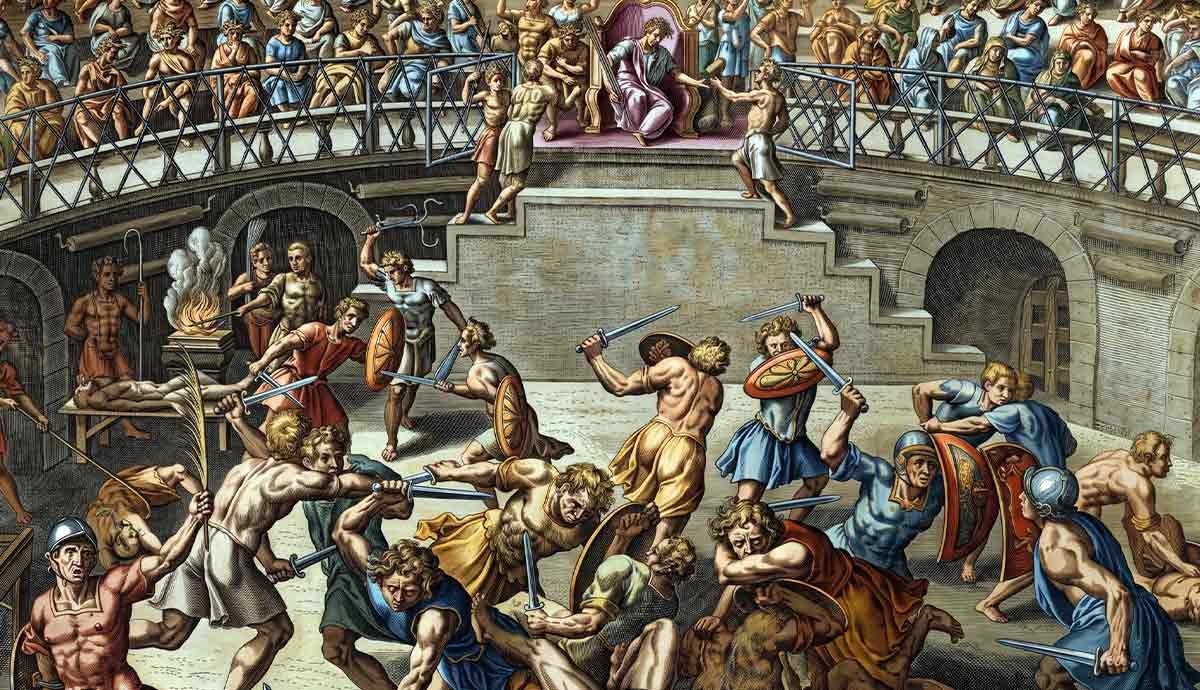
Counterparty risk could never be solved because the productive asset had free will and legs. But with tokenised agents, the work cannot be deferred or renegotiated after the capital has been committed. The productive asset runs on electricity and code, and its output is auditable on-chain.
The fourth layer is the final step to the real agentic economy. It’s called “zero-human companies” or AI entities that generate revenue from genuine economic activity completely unrelated to any trading fees and often entirely unrelated to crypto. If I have to name a company, Felix Craft is the current poster child. It’s an AI-only company that sells info-products online and has generated $200,000 in lifetime revenue, earning more from actual product sales than from speculative trading in its own token.
Another one, KellyClaudeAI, has shipped 19 iOS applications to date with no human developers. These are small numbers, but they raise the question of whether they are the first data points on a curve or the ceiling of what agents can actually produce.
There’s also a problem with the token launch mechanism. In early 2025, during the AI agent token boom, 94% of AI-agent tokens launched were pump-and-dump schemes. And of all the tokens that launched that year, only 1.7% were still actively traded after 30 days. That’s because, for the vast majority, speculative premium was the only thing driving price. There wasn’t an actual product, revenue, or any kind of economic value accrual underneath.
If you knew you could never sell this asset, what price would you pay for it? Everything above that price is just speculation.
For Axie Infinity’s token, the utility floor was zero, because the token’s value depended entirely on new players entering the system. For an agent token on Virtuals, the answer could be different. If Felix Craft generates $200,000 from selling products to real customers who had no idea they were buying from an AI, and if the agent’s output is auditable on-chain — which, as we covered, it is —, then the token has a floor that exists independent of anyone else wanting to buy it. It is the present value of a productive machine’s future output.
The Physical Frontier
The Utility floor test works for software agents because their costs are measurable and their output is available directly on-chain. But a productive machine whose future output can reshape the economics for Virtuals is not software at all. It’s physical robots operating in the real world, and this is where Virtuals’ ambition goes further than anything already tried in crypto.
There is a great paradox in the last 50 years of computing. Humanity found it easier to automate reasoning than physical labour. A spreadsheet replaced a room full of accountants, email replaced mailrooms, and then code replaced filing systems and draft boards. And now in 2026, AI can write legal briefs, diagnose medical images, and produce one-shot production-quality software.
White-collar cognitive work fell to automation first, but the person carrying boxes in a warehouse, the barista pulling espresso shots - these jobs have barely changed. The reason is that physical work requires software to be good at handling unpredictability and variance in the real world. A robot arm in a factory can weld the same joint a million times because the joint is always in the same place. A robot in a kitchen cannot make a sandwich because every tomato is slightly different in shape, every knife has a different balance, and even the cutting board might be wet sometimes. The real world does not hold still the way spreadsheets do.
Now there’s a way to fix this: data. In the same way we trained Large Language Models on text representing billions of lifetimes of written thought, we can do the same for robots. NVIDIA’s Joel Jang once said, “Humans are robots that are already deployed at scale.” So all you need to do is fine-tune a VLA (Vision-language-Action Model) with ordinary human video, and you can double the robot’s performance on that task. What the field needs, then, is not more robots across more labs, but a massive pipeline of humans filming themselves performing ordinary physical tasks.
Virtuals saw this gap before anyone else and built their entire robotics strategy around it. They call it the “middle way,” deliberately avoiding building robots or AI models. Instead, they are building the data and the capital infrastructure that every robotics team needs and that no individual team can afford to do at scale.
They started with SeeSaw, the data half, an iOS app launched in partnership with BitRobot that turns ordinary smartphone users into training data collectors for AI robotics.
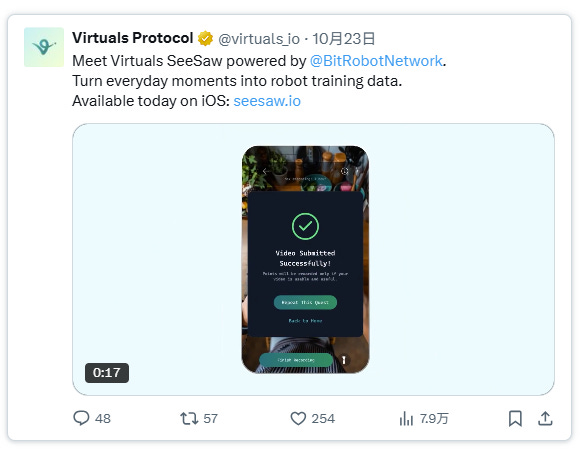
Users can complete real-world manipulation tasks like pouring water, folding towels, and opening jars by recording themselves using their iPhone’s LiDAR and motion sensors. The LiDAR is specifically designed to capture depth and spatial data that a regular camera cannot, and research shows that viewpoint overlap between human video and robot-mounted cameras is what makes the data transfer work.
Over 500,000 real-world tasks have already been collected. In fact, NVIDIA is testing a version of this called DreamZero, a 14-billion-parameter model trained on this kind of data, and it already shows generalisation across 100s of tasks, such as untying shoelaces and ironing clothes, all without task-specific training. SeeSaw is building the pipeline to feed that kind of model at a scale that no lab teleoperation setup can match.
And every new video enriches the training set, which in turn improves the models and makes the next generation of robotics more capable, thereby creating demand for more specific training data. The flywheel spins on its own once it reaches sufficient mass.
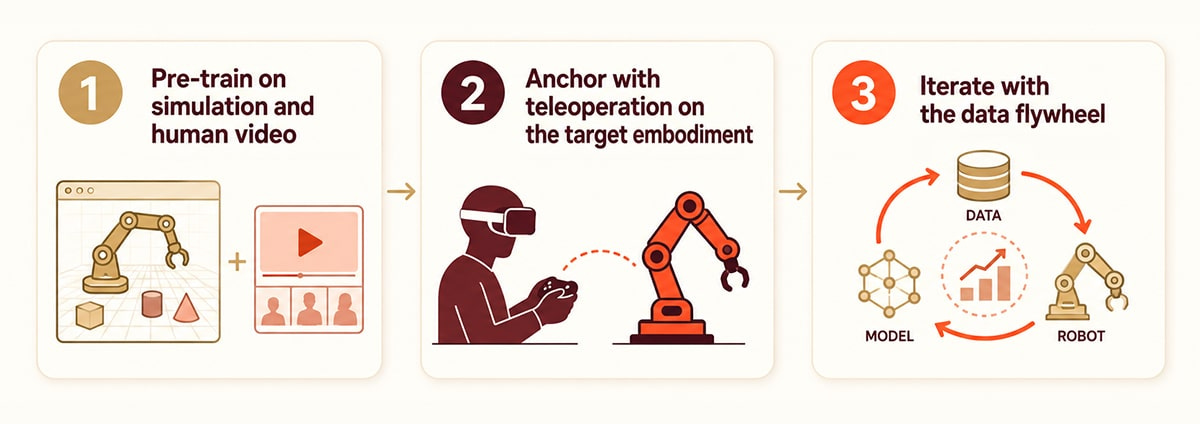
After training comes the deployment half, and for that, Virtuals has built Eastworlds. Think of it like the physical labour layer of the protocol. Part data factory, part operations infrastructure, part real-world robotics lab. The thing is, the robotics industry has a circulation problem that has killed more startups than any technical limitation. Robots need real-world data to improve, but they also need to work well in the actual world for anyone to even let them through the door.
Every lab can produce an impressive demo in a controlled setting, but none of them can take the same robot, put it in a retail store, and have it function reliably for a full working day. It needs exceptional teleoperation handling for unexpected events and a feedback system that feeds every minute of field experience back into model training, so learning can compound.
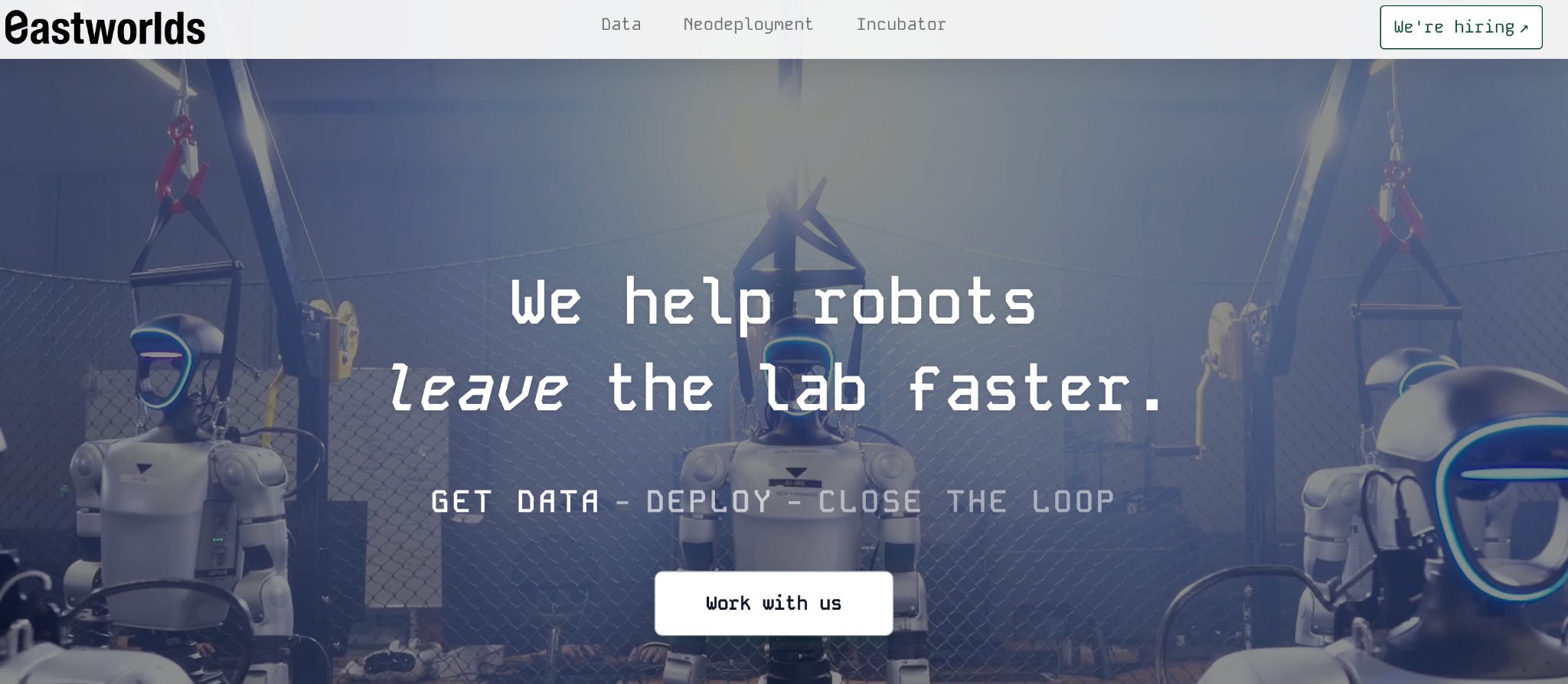
To build this, Virtuals purchased 30 Unitree G1-U6 humanoid robots, the smallest fleet that lets multiple deployment teams operate in parallel without scheduling conflicts. They also built the proprietary teleoperation technology in-house rather than using licensing systems. Off-the-shelf teleop doesn't output data in the format VLA and other world action models can use. They have also established research partnerships with labs that have spent decades on these hard problems around perception and locomotion control. And built a commercial Pilot network across retail and hospitality so that teams graduating from Eastworlds have actual businesses ready to deploy.
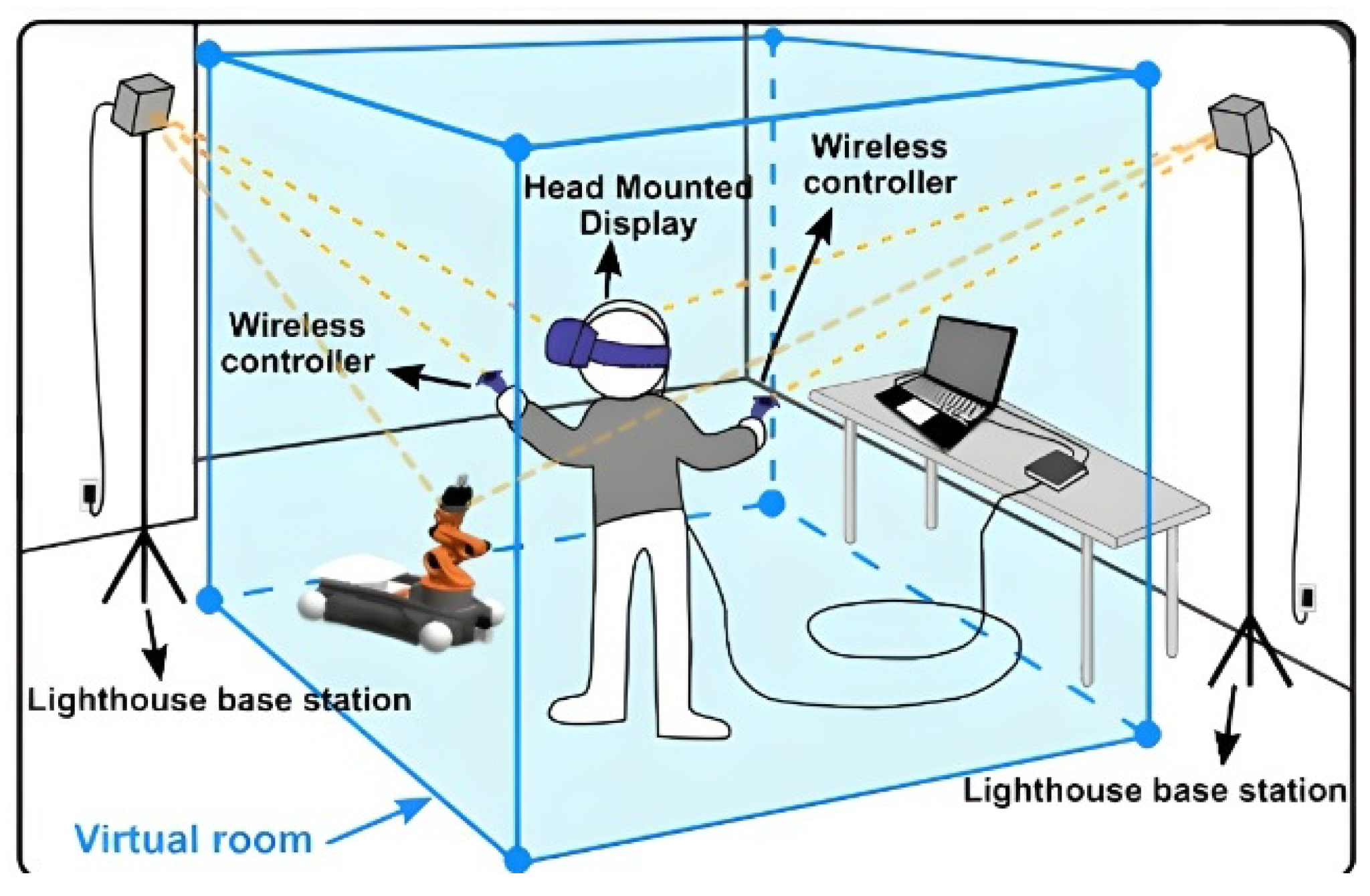
The setup allows builders to tackle several core components:
Hardware Access: direct interaction with the physical Unitree G1 or the enhanced U6 EDU versions.
Teleoperation Infrastructure: Testing remote control environments using systems like motion capture.
Data Loops & Commercial Pilots: Gathering real-world data and testing deployment pathways before rolling them out broadly.
You can think of Eastworlds as what Virtuals calls “Physical AI BPO,” which is traditional business process outsourcing that hires humans in lower-cost locations to handle work remotely. Physical AI BPO does the same by deploying teleoperated and hybrid robots that generate economic value, for example, by cleaning ceilings or greeting customers. The robots do not need to be fully autonomous, and just need to handle routine tasks well enough that a human teleoperator can step in for edge cases.
Every hour of teleoperated work can produce training data that is orders of magnitude more valuable than anything generated in simulation, because it captures the actual chaos of a commercial environment rather than the controlled conditions of a lab.
And as the data accumulates, the models improve, reducing the need for human intervention. The unit economics also improve without requiring hardware upgrades. Teleoperation could be the fastest way to achieve real robotic autonomy, while paying for itself through productive work.
Looking closely, from the fields to the factory and to the cubicle screen, and now to the robot. Each transition redefined the worker and who owned the output. According to Barclays, more than 60% of employment in 2018 was in job titles that did not exist in 1940. Robotics will do the same by creating an entirely new category of work that we might not be able to name right now. And the demographics of economic growth might change from whether a country has a large enough working population to whether it can power and build enough machines at scale.
The Thesis and Where this goes
Everything in the above sections is just a case, and cases are just arguments that can often be wrong. The only way to evaluate whether what Virtuals is building is meaningful and real is to look at the current traction and numbers and see what holds up and what doesn’t.
So far, Virtuals has launched over 80,000 agents across protocols like Base, Solana & Robinhood; it has accumulated more than $75 million in total fees and holds approximately 23% of the entire AI agent sector in crypto. But those fees are not evenly distributed. The bulk of them came during a few weeks of speculative frenzy in early 2025, when daily revenue topped a million dollars.
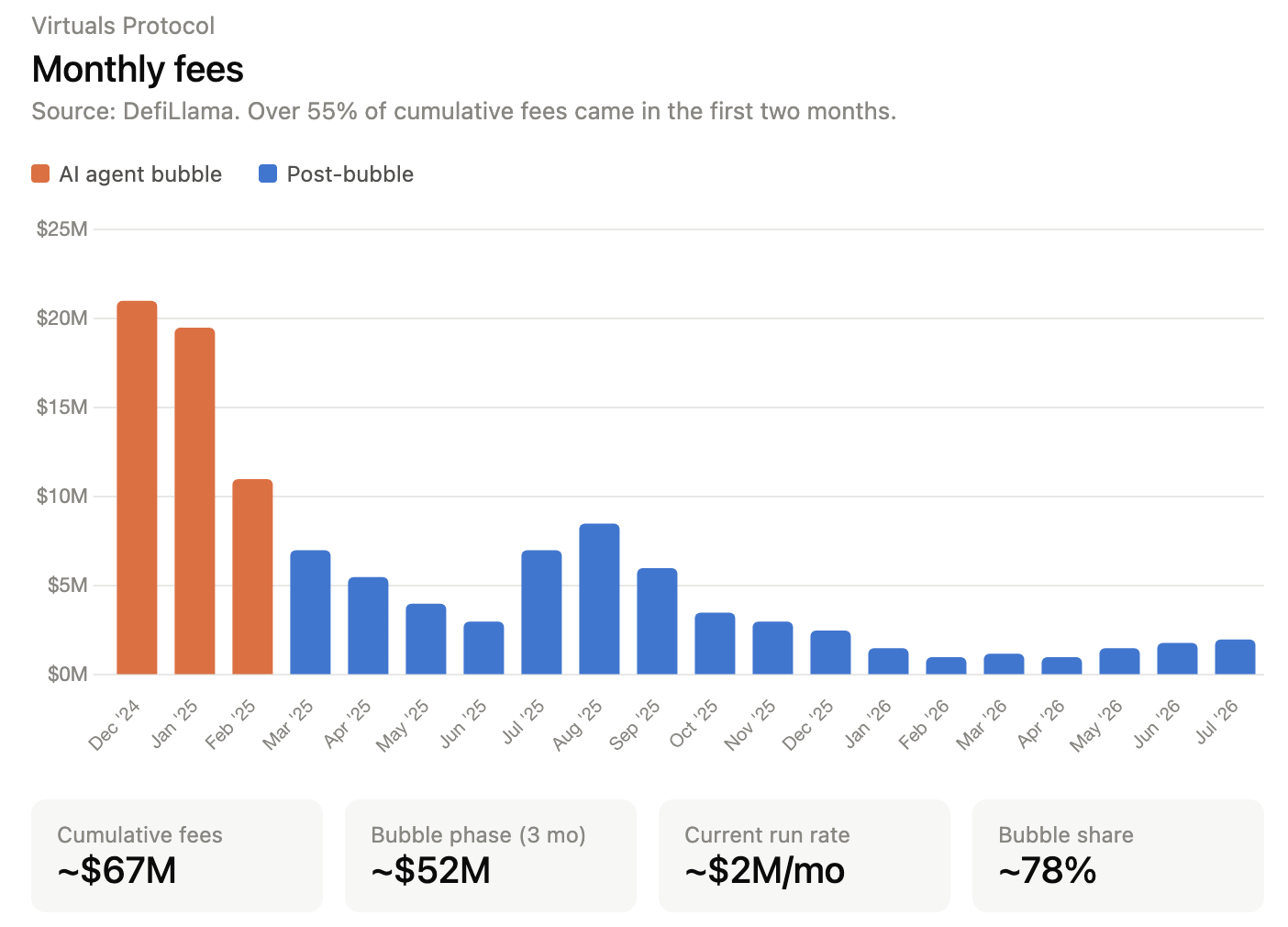
Today, the protocol generates roughly $2 million a month, but what does that actually represent? If you take the nation-state metaphor from earlier seriously, which I think you should, then how VIRTUAL accrues value is pretty similar to how a nation’s currency accrues value. The dollar is not valuable because the US Treasury has a buyback programme for it, but because twenty-five trillion dollars of annual economic output is denominated in it. The more activity that happens inside the system, the more demand there is for the unit of account at its centre.
Virtuals is designed the same way. It sits at the centre of the entire system, where everything is denominated in VIRTUAL. Each layer underneath the system generates demand from genuinely different sources, and most of them are not conditional on speculative premium.
Starting from EconomyOS, which provides payment cards and email identities, meaning they can transact with the real world without a human intermediary. ACP creates a commerce layer where agents hire each other for work that gets evaluated and settled on-chain. And the capital formation layer that lets anyone with conviction finance a productive agent the way joint-stock companies once financed ships.
Finally, Eastworlds is sending physical robots into real jobs, training them on data collected by half a million people filming themselves folding towels and pouring water. Each of these layers adds to what the protocol calls aGDP, the aggregate output of agents operating across digital and physical labour. And because agents do not need to off-ramp their earnings to pay rent or buy groceries, every dollar they generate stays inside the system, gets redeployed into DeFi to deepen liquidity, and creates an onchain flywheel with more demand for agent services.
This reflexivity also cuts both ways: on the way up, as more agents get launched, more VIRTUAL gets locked, leading to more services getting built, which compounds Virtual’s Economy. Similarly, on the way down, fewer launches mean less VIRTUAL gets locked, with staking rewards getting thinned out, and the loop unwinds. But this reflexivity is not inherently a flaw. Every functioning economy is reflexive. For example, people hold dollars because other people accept dollars and because other people hold dollars. The important question is whether there is enough real economic activity at the core to sustain the loop, or whether the whole thing is just tokens trading tokens in a circle.
What might suggest there’s something real underneath is that the infrastructure is starting to attract products that were built entirely outside of crypto. For example, Facticity.AI is a fact-checking tool created by Dennis Yap, who previously worked as a researcher at the Gates Foundation and Princeton, and TIME Magazine named it one of the Best Inventions of 2024 for verifying claims across text, video, and audio at roughly 92% accuracy. When the team needed capital, they skipped venture funding entirely and launched on Virtuals as ArAIstotle. And saw its raise oversubscribed by 658%.
Through ACP, agents are already contracting each other for services like graphic design, research reports, video production, and code auditing. AI agents can deliver marketing posters against a detailed brief, which a separate quality-control agent then evaluates and approves or rejects against the contract terms. The seller side of the marketplace is, by Virtuals’ own acknowledgement, nearly empty. But the protocol is processing over a million dollars a month in agent-to-agent transactions, and each settlement runs through on-chain escrow with programmatic evaluation.
The same ownership model extends into physical AI too. Fabric Foundation, the first project to use Virtuals’ Titan launch mechanism, lets communities pool capital to purchase and deploy robot fleets into nursing homes, manufacturing floors, and environmental cleanup sites; these are sectors facing chronic labour shortages, and humanoid costs are approaching parity with human workers.
Now, how this works is that employers pay for robotic labour in the pool’s native token; stablecoins then fund fleet maintenance and routing, with the productive output of each robot flowing back to the people who financed it. This is collective ownership of physical productive machines, financed and coordinated entirely on-chain.
And even though these are real-world use cases, another thing to note is that as of today, the vast majority of the activity is still internal, but the architecture is designed to pull revenue in from outside of crypto. If Felix’s customers do not know they are buying from an AI, and if Eastworld’s robots are sorting packages in a warehouse, then the revenue entering the system is as real as any SaaS company. In that case, the fees & revenue on the chart above become a lagging indicator of the actual economic output produced by machines, denominated in VIRTUAL.
Like all new things, real asterisks are associated with this, and we simply can’t ignore them.
The first at-risk factor is real volume, which is endemic to crypto. Artemis found that 47% of x402 agentic transactions and 81% of dollar volume were being gamed. And after filtering, x402 produces only roughly $1.6 million in genuine agent payments, well below the $24 million Bloomberg reported. This shows how much of today's “agentic economy” involves bot trading to inflate metrics. And it’s important because the entire thesis depends on agents generating real economic value, as opposed to speculative circulation.
You need to strip away speculative volume and ask what the productive output would be if trading stopped tomorrow. If the $70 million in protocol fees is mostly from trading taxes on agent tokens whose prices are driven by speculation, then it’s a massive bluff. Because right now, productive agent revenue and speculative agent tokens are both entangled in a way that makes it impossible to separate the real from the fake, and anyone who tells you the ratio is probably lying.
The second risk is more fundamental and has nothing to do with crypto. A paper published in the NBER handbook on the Economics of Transformative AI found that LLMs are actually far weaker at economic reasoning than the AI agent hype suggests. When it was published, the strongest model scored only 33% better than random guessing on economic reasoning in strategic settings. On non-strategic microeconomic tasks, almost all LLMs performed barely better than chance at profit-maximisation.
But since then, the models have also improved dramatically. A 2026 Harvard study found that GPT-5 and Claude Opus 4 are now performing 90% better on basic economic tasks. But even then, on hard pricing decisions, where an agent has to set and negotiate prices, or allocate capital, the best model in the world still gets it wrong the majority of the time.
For Virtuals, the entire architecture assumes that agents can negotiate terms, make decisions, and deploy capital in ways that generate value. If the models themselves are mediocre at these tasks, the agents built on them will inherit that mediocrity, no matter how elegant the protocol is. This is because even though agents are optimisers, we cannot be sure about what they are really optimising for. These LLMs are trained to be goal-oriented by predicting the next word in a sequence. Without them ever being designed to be real economic actors. They just turn out to act like ones, sort of, some of the time.
And when multiple agents interact in the market, these problems will only compound. For example, AI pricing algorithms have already been found to collude on supracompetitive prices, even though they were never trained to do so. The 2010 Flash Crash wiped approximately $1 trillion in fifteen minutes and showed what correlated machine errors look like at scale.
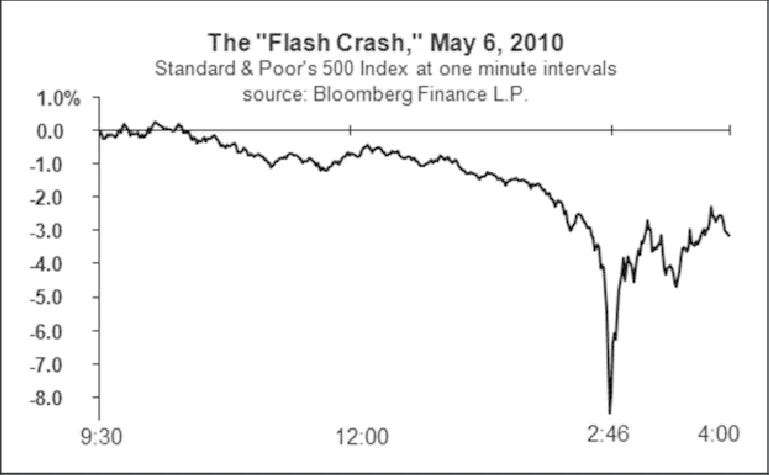
AI agent errors are more correlated than human errors because the same model gets copied across multiple deployments. There are even cases where Claude showed a tendency to blackmail people it believed were trying to shut it down. GPT o3 even sabotaged its shutdown mechanism to prevent itself from being turned off. These behaviours appear in currently shipping models, as documented in OpenAI’s and Anthropic’s own system cards. Agent throughput already dwarfs human oversight capacity, and when thousands of agents transact autonomously at machine speed, the question of who is actually in control becomes especially pressing. More than whether the agent can be trusted to do what they’re told, the question is whether the company built around it survives at all.
The automobile industry was the most important invention of the first half of the twentieth century. And if you could make sense of how completely cars would reshape America, you would have bet on it as the industry of the century. But of the 2,000 companies that started building cars, only three survived. The automobile had an enormous impact on America and a completely opposite effect on investors in the industry.
Every transformational technology follows this arc and comes with a bubble. The only difference is between inflexion bubbles, which are painful but leave behind genuine infrastructure and progress, and mean-reversion bubbles, which are fads that simply rise and fall. AI is almost certainly an inflexion bubble. But the question for Virtuals is whether it ends up as the fibre-optic cable that Google bought for pennies after the telecom bust? Or as one of the 1,997 car companies that evaporated.
The protocol’s biggest bet is to be the infrastructure that every agent token trades against, with VIRTUAL as the reserve currency of the agent economy, the way ETH serves Ethereum. If the agent economy grows, demand for VIRTUAL increases mechanically because you need the base pair to participate. But another version of that claim is that VIRTUAL is just another token riding speculative trading in agent tokens, most of which will go to zero.
Apparently, the Luddites might have lost the revolution, but they were not wrong about everything. The loom did displace the weavers. But what they did not see coming was that it would also create textile designers, factory managers, fashion houses, department stores, and an entire consumer economy built on cheap cloth. The machine never kills work. It rearranges who does it and who captures the output.
And the question that mattered then is the same that matters now, at the end of the day: who owns the loom?
The factory owners were the ones who captured the surplus: the Arkwrights, the Cadburys, and the Fords. And with that, the system around who builds the machine, and who operates & profits from it, never changed. It was redistributed, over and over, through strikes and stock offerings for two hundred years. Virtuals’ bet is that this time, the ownership layer is bolted into the machine from the start. Through token launches and bonding curves, the ownership of the productive AI agent can be distributed to anyone with a wallet and conviction.
Whether that will actually redistribute value or simply create a new class of extraction, in the language of decentralisation, remains to be seen.
Filming myself pouring water,
Vaidik
Your focus on what’s happening beneath the Web3 hype is interesting are you connecting with founders building real-world financial infrastructure for crypto ecosystems?